Grandmother joins suicide bombing campaign

A 64-year-old grandmother became the oldest Palestinian suicide bomber when she blew herself up near Israeli troops.

Grandmother joins suicide bombing campaign

A 64-year-old grandmother became the oldest Palestinian suicide bomber when she blew herself up near Israeli troops.

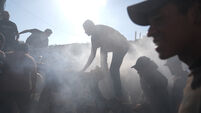
As Israeli forces were moving through the Jebaliya refugee camp north of Gaza City yesterday afternoon, they spotted a woman acting suspiciously. Soldiers threw a stun grenade, a weapon that makes a loud nose but causes no damage. Then the woman set off explosives she was carrying, killing herself and slightly wounding two of the soldiers.

The militant Hamas, which is in charge of the Palestinian government, claimed responsibility and identified the bomber as Fatma Omar An-Najar. Her relatives said she was 64 – by far the oldest of the more than 100 Palestinian suicide bombers who have attacked Israelis over the past six years.

She lived in Jebaliya town, next to the refugee camp where she tried to blow up Israeli soldiers.

An-Najar took part in a women’s demonstration to divert Israeli troops while Hamas militants escaped from a mosque earlier this month, reflecting increased involvement by Gaza women in the struggle.

At the compound where the extended family lives, her oldest daughter, Fatheya, explained her motives. “They (Israelis) destroyed her house, they killed her grandson – my son. Another grandson is in a wheelchair with an amputated leg,” she said. “She and I, we went to the mosque. We were looking for martyrdom.”

Female suicide bombers were a rarity during the first several years of the current conflict, but this has gradually changed. The last suicide bombing, on November 6, was also carried out by a woman in northern Gaza.

Eight other Palestinians were killed yesterday, the second day of Israel’s current operation in the area where militants fire their homemade rockets at nearby towns like Sderot.

Israeli defence minister Amir Peretz was in Sderot, where he lives, when the alarm warning of a rocket attack sounded. Channel 10 TV showed him being hustled by security officers into a concrete-lined room, and seconds later the explosion of two rockets could be heard clearly. Militants fired three others, the military said.

Palestinian president Mahmoud Abbas denounced the Israeli raids, using terms like massacre and barbaric, but blamed the rocket squads for setting it off. “There is no need for these rockets, because the action of these rockets will not reach the level of the Israeli reaction,” he told his Fatah Party late yesterday.

Adopting techniques used by Hezbollah guerrillas in the summer war with Israel, Palestinian militants fired at least two rocket-propelled grenades at one of their own buildings – a house in Gaza taken over by Israeli forces. There was no word on Israeli casualties.

The escalating violence added urgency to diplomatic efforts to defuse the situation as the supreme leader of Hamas, Khaled Mashaal, who is based in Damascus, started talks in Cairo with Egyptian mediators.

Hamas officials said two items were on the agenda – a prisoner exchange with Israel and a new Palestinian government. No announcement was made after the talks between Mashaal and the chief of Egyptian intelligence, Omar Suleiman, Egypt’s point man for the Israeli-Palestinian dispute.

The capture in late June of an Israeli soldier by Hamas-linked militants who tunnelled under the Gaza border set off the latest Israeli offensive in Gaza. Israel insists that the soldier must be returned before other issues are discussed.

However, issues like the numbers, sequence and the list of prisoners to be freed are still open, and each could be a deal-breaker, holding up efforts for a new cease-fire to replace one negotiated in 2005 that largely held for a year.

Mashaal was to discuss prospects for a new government to replace the Hamas-led Cabinet in charge of the Palestinian areas since March. The West cut off vital foreign aid, charging that Hamas is a terror group. Efforts to agree on a moderate Cabinet with Fatah input have stalled.

Abbas told his party that before a government is formed, a cease-fire must be in place, the Israeli soldier must be freed and dozens of Palestinian members of parliament and Cabinet ministers held by Israel must be released.

x

More in this section

Cookie Policy Privacy Policy Brand Safety FAQ Help Contact Us Terms and Conditions

© Examiner Echo Group Limited