Britain and France clash over EU defence spending
Britain and France clashed today over the budget of the European armaments agency.
London opted not to join a new EU defence research programme to develop high tech battlefield protection for European troops.

The spat prevented an agreement on a three-year spending plan for the European Defence Agency. Instead, EU defence ministers were able only to adopt an annual budget for the body - €22.1m for 2007.
Britain also decided to stay out of the agency's first major research project - a three-year plan to develop force protection technologies.
Nineteen European nations signed up to the project today, agreeing to spend €54m on research in equipment such as body armour, sniper detection and secure communication.
Britain argues it is already heavily engaged in research in such fields, using its experience in Iraq and Afghanistan.
It fears joining the EU project would duplicate those efforts. However, the decision and its objections to higher longer-term spending for the armaments agency have triggered speculation that London's commitment to EU defence co-operation is waning.
Such concerns were dismissed by Nick Witney, the head of the EU defence agency. "I certainly do not interpret it as a general disenchantment," he said.
In a news conference, he hailed the agreement by the 18 EU members and Norway to pool research on force protection as a landmark for European defence efforts. France, Germany and Poland will be taking a lead in the three-year project.
"Europe needs to spend more and to spend more together," Witney said. "This is a very substantial first step in that direction."
He also announced that France, Sweden, Finland, Spain and Italy had agreed to invest up to €100m in research into new high-tech radios for the military.
Britain and France are the European Union's biggest military powers and have taken a lead in pushing other members of the bloc to increase defence spending and boost cooperation to give the EU stronger forces.
However, they have also frequently differed over the approach to Europe's defence, with Britain placing greater emphasis on Nato and ties with the United States, while France seeks to build up a more autonomous European military capacity.
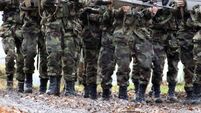
The defence ministers did announce progress on a major initiative launched by France and Britain in 2004 - the development of a pool of EU "battlegroups" made up of around 1,500 highly mobile troops ready for quick deployment to world trouble-spots. They declared that the plan will be fully operational from January.
Already working on a provisional basis, the plan assigns reaction-units for EU duty on six-monthly rotations. For the first half of 2007, the bloc will have a Franco-Belgian battlegroup at its disposal and another formed by troops from Germany, Finland and the Netherlands.
EU nations have now committed troops for rotations through to the end of 2008.