Baghdad recovers after snipers attack pilgrims

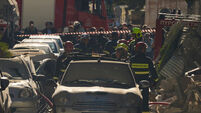
Baghdad was busy today after a two-day lockdown during a Shiite religious commemoration that was disrupted by sniper attacks on pilgrims in another spasm of sectarian bloodletting.

Baghdad recovers after snipers attack pilgrims

Baghdad was busy today after a two-day lockdown during a Shiite religious commemoration that was disrupted by sniper attacks on pilgrims in another spasm of sectarian bloodletting.

The government said 20 people were killed by the snipers who hid in buildings and sprayed bullets into Shiite religious processions yesterday. The US military, however, claimed only five people were killed. The discrepancy in the toll could not be immediately reconciled.

Today, major intersections were clogged with vehicles that had been ordered off the streets since Friday night to prevent car bomb attacks on pilgrims. A virtual curfew had gripped the capital on Saturday and yesterday, and few people were seen except pilgrims.

Prime Minister Nouri al-Maliki, a Shiite, thanked the armed forces for preventing major attacks.

“We condemn strongly the terrorists attacks committed by the terrorists against innocent civilians,” he said in a statement.

“The success of the army and the security forces in preventing the terrorists from killing (a larger number of) innocent people – although some fell as martyrs – reflects the rising power of the armed forces,” he said.

Hundreds of thousands of Shiites had marched in processions to the shrine of Imam Moussa Kadhim, an 8th century saint, in Kazimiyah in north Baghdad. Some processions were ambushed by snipers when they passed three or four Sunni neighbourhoods.

“I was walking and someone got shot in front of me. It wasn’t random fire, it was a clear sniper attack,” said Mohammed Jassim, 32.

He said he could hear the faint crack of shots over the noise of the procession. “People panicked and started yelling: ’It came from here, no from there.”’

Nevertheless, the day’s main ceremonies went off peacefully at the golden-domed shrine where Kadhim is buried. Shiites believe that Kadhim, who died in AD 799, was poisoned in prison by a Sunni caliph.

The Sunni-Shiite rivalry, which predates Kadhim, continues to this day. Extremists among the two communities have been carrying out tit-for-tat attacks since the February 22 bombing of a Shiite mosque in Samarra.

Many people are especially worried about sectarian violence, which is claiming about 100 lives a day across Iraq and stoking fears that the country could slide into civil war.

About 12,000 extra US and Iraqi soldiers have been deployed to Baghdad in recent weeks as part of a security crackdown on a surge of insurgent attacks and sectarian bloodshed in the capital.

Despite the sense of relative normality, Baghdad remained on guard Monday against possible attacks on the mile-long lines of cars at gasoline stations, a favourite target of insurgents.

Street cleaners and municipal workers carefully sifted through garbage, in which improvised booby-trapped bombs have been placed in the past.

Last year’s Kadhim commemoration also was marred by deaths, when rumours of suicide bombers triggered a mass stampede on a bridge across the Tigris River. The government said about 1,000 people died in the worst single day death toll since the US-led invasion in March 2003.

Shiites were prevented from assembling in large numbers at religious ceremonies during Saddam Hussein’s Sunni-dominated regime. But since his ouster, Shiite politicians and religious leaders have encouraged huge turnouts as a demonstration of the majority sect’s power.

Saddam goes on trial for a second time Monday, charged with genocide and war crimes from his scorched-earth offensive against Kurds nearly two decades ago in which 50,000 to well over 100,000 people were killed.

x

More in this section

Cookie Policy Privacy Policy Brand Safety FAQ Help Contact Us Terms and Conditions

© Examiner Echo Group Limited