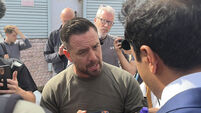
Rice meets Lebanese in Beirut

In a surprise visit to Beirut today, US Secretary of State Condoleezza Rice praised the beleaguered prime minister of Lebanon for his courage in struggling to contain the fighting between the Hezbollah militia and Israel.

Rice meets Lebanese in Beirut

Lebanon’s parliament speaker has rejected proposals brought by US Secretary of State Condoleezza Rice today, insisting a ceasefire must precede any talks about resolving Hezbollah’s presence in the south, an official close to the speaker said.

Ms Rice’s talks with prime minister Fuad Saniora in Beirut also appeared to have been tense. Mr Saniora told Ms Rice that Israel’s bombardment was taking his country “backwards 50 years” and also called for a “swift cease-fire,” according to his office.

David Welch, an assistant secretary of state travelling with Ms Rice, said later that it was “unfair” to say her meeting with parliament speaker Nabih Berri went poorly. Mr Berri is widely seen as negotiating on behalf of Hezbollah.

An official close to him said his talks with Ms Rice failed to “reach an agreement because Rice insisted on one full package to end the fighting.”

The package included a ceasefire at the same time as the deployment of the Lebanese army and an international force in south Lebanon and the removal of Hezbollah weapons from a buffer zone extending 30 kilometres from the Israeli border, said the official. He spoke on condition of anonymity because the talks were private.

Mr Berri rejected the package, proposing instead a two-phased plan that required an immediate easefire, but leaving until much later the question of moving the Lebanese army into the south – which is a key demand of Israel and the United States.

Under Mr Berri’s plan, first would come the ceasefire and negotiations for a prisoner swap. Then the issue of how to deal with Hezbollah’s presence in the south would be determined by an intra-Lebanese dialogue.

Lebanese parties – including Hezbollah, pro-Syrian and anti-Syrian factions - held weeks of the so-called “dialogue conference” this spring, but no headway was made on what to do with the south or whether to disarm Hezbollah.

The US has insisted that no cease-fire can take place without dealing what it calls the root cause of the violence – Hezbollah’s domination of the south along the Israeli border. Israel has rejected any halt in the fighting until two soldiers captured by the guerrillas are freed and the guerrillas are forced back.

The US has said an international force might be necessary to help the Lebanese army move into the south.

The central government has long refused to send the army in, insisting Hezbollah is a legitimate force and fearing that doing so would lead to clashes between the guerrillas and the army and could tear the country apart on sectarian lines.

In a sign of the differences between the US and Lebanon, Saniora presented his own package for a permanent solution that contained long-standing Lebanese complaints that must be addressed before “Lebanese authority can be spread over all areas,” his office said.

It included a call for a “swift ceasefire.” Then would come an over-all solution guaranteeing the return of Lebanese prisoners held by Israel, Israel’s withdrawal from the Chebaa Farms – a tiny border region that Lebanon claims - and the provision of minefields lain in south Lebanon during its 18-year occupation of the region.

Saniora met with Berri soon after Rice left Lebanon. Saniora has come out in favour of sending the military into the south in principle, but has insisted the Chebaa Farms issue must be resolved first.

x

More in this section

Cookie Policy Privacy Policy Brand Safety FAQ Help Contact Us Terms and Conditions

© Examiner Echo Group Limited