124 die in Russian plane crash
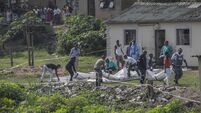
A Russian passenger plane skidded off a rain-soaked Siberian runway early today, ploughed through a concrete barrier and burst into flames killing at least 124 people.
Another 68 people were taken to hospital, the Emergency Situations Ministry said.
The Airbus A-310 belonging to Russian airline S7 was carrying 201 people on a flight from Moscow to Irkutsk. Airline spokesman Konstantin Koshman said there were 193 passengers – including 14 children under the age of 12 – and eight crew.
Koshman said there were 11 foreigners on board, from Germany, South Korea, Poland, China and Moldova.
Many of the children were headed to nearby Lake Baikal on holiday, according to Russian news reports.
The plane veered off the runway on landing and tore through a six-foot-high concrete barrier. It then crashed into a compound of one-storey garages, stopping a short distance from some small houses.
It was not immediately clear whether anyone was in the garages when the plane slammed into them at about 7.50am local time (11.50pm Irish time yesterday).
“I saw smoke coming from the aircraft. People were already walking out who were charred, injured, burned,” eyewitness Mikhail Yegeryov told NTV television.
“I asked a person who was in the Airbus what happened, and he said the plane had landed on the tarmac but didn’t brake. The cabin then burst into flames,” Yegeryov said.
Transport Minister Igor Levitin blamed the wet runway.
“The aircraft veered off the runway. There was rain, the landing strip was wet. So we’ll have to check the clutch and the technical condition of the aircraft,” he told Russian state television.
The Prosecutor-General’s Office said that investigators considered a technical fault or human error as the two most likely versions of the crash, Russian news agencies reported. Koshman, the airline spokesman, said the plane had been regularly maintained and met all certifications.
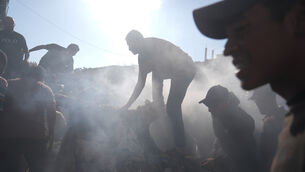
It took firefighters more than two hours to put out the fire, Emergency Situations Ministry spokeswoman Irina Andrianova said. There were two explosions caused by fuel in the plane, Moscow radio reported.
Russian television showed smoke rising from the wreckage and firefighters clambering on top.
“It was travelling at a terrific speed,” Andrianova said. She said the front end of the plane was crumpled in the crash 2,600 miles east of Moscow.
President Vladimir Putin conveyed his condolences to friends and family of the victims and declared tomorrow a national day of mourning.
Details began to emerge of the chaotic aftermath of the crash. One air stewardess, Viktoria Zilberstein, opened the emergency hatch in the rear of the aircraft and let a number of passengers out, said the Emergency Ministry’s regional branch.
Ten passengers managed to escape this way and other survivors, including a pilot, were rescued by firefighters and rescuers from the burning wreckage, ITAR-Tass reported.
The transport minister said the aircraft’s two black boxes had been recovered and were being deciphered.
Levitin added that the pilot had radioed ground control to say the aircraft had landed safely and then communication cut off.
Relatives began to arrive at Moscow’s Domodedovo airport today, from where the plane took off.
In May, another Airbus aircraft crashed in stormy weather off Russia’s Black Sea coast as it prepared to land, killing all 113 people on board. Airline officials blamed the crash of the Armenian passenger plane on driving rain and low visibility.
In March 1994, a half-empty Airbus A-310 belonging to Russian state airline Aeroflot crashed near the Siberian city of Novokuznetsk, killing 70 people. Investigators said the crash was caused mainly by the pilot’s teenage son inadvertently disconnecting the autopilot.
Today’s disaster was the fourth air crash in Irkutsk in the past 12 years.
CONNECT WITH US TODAY



Be the first to know the latest news and updates