Machete mob raids attorney general's office
A mob armed with machetes looted East Timor’s attorney general’s office today, including an area where evidence of 1999 massacres linked to the country’s breakaway from Indonesia were kept.
Looters smashed windows and locks to break into the Serious Crimes Unit at the office, staff member Abilio Reis said.
Evidence of alleged massacres committed in 1999 by militias allied with Indonesia, the country’s former ruler, was strewn over the floor. The mob had entered several other offices in the building, and looted computers and other valuable items.
“I was afraid. I tried to stop the looting, but couldn’t,” Reis said. United Nations security guards had fled the scene, he said.
It did not appear as if the attackers were deliberately trying to destroy documents related to the earlier violence, which have never been publicly released and remain a symbol of the traumatic period.
Up to 1,500 people died at the hands of the Indonesian military and pro-Jakarta militias after East Timorese voted overwhelmingly for independence.
Dozens of low-level militiamen have been jailed in East Timor, but most of the leaders fled into exile and now live freely in Indonesia. East Timor’s government has made muted demands for justice, saying it is more interested in reconciliation with its giant neighbour.
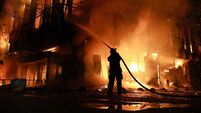
Fighting broke out in several other areas of the capital today and scattered arson and looting continued, despite the presence of more than 1,300 foreign peacekeepers in the city.
Ambulances were seen ferrying injured people to a hospital, but it was not immediately clear how many had been hurt.
At a warehouse being used as a food-distribution centre, scuffles broke out as thousands of residents, many of whom fled their homes to escape the violence in the smouldering capital, pushed and struggled to get bags of rice.
Australian troops struggled to keep order.
“We need more food. The situation is terrible,” said Daniel Afonso, who fled his destroyed home with his parents and four children and is staying at a church refugee centre.
“It is dangerous to go out looking for food and the shops are closed,” he said.
The capital appeared more tense than yesterday, when foreign peacekeepers made a show of force, throwing machete-wielding youths to the ground and handcuffing them as residents looked on. But the foreigners have no arrest powers and the detainees were soon freed.
Political leaders held a second day of meetings to try to defuse the crisis. Heavily-armed Australian and East Timorese troops guarded the palace, where anti-government protesters called for the prime minister’s resignation and helicopters and armoured personnel carriers patrolled nearby.
Yesterday, revered President Xanana Gusmao, who wields enormous status as the hero of East Timor’s independence, told a crowd to be patient and promised a solution would be soon be found.
Alkatiri has become a figure of blame for the crisis, which started last week with sporadic clashes between former soldiers and government troops and spiralled into open gang warfare, looting and burning. At least 27 people have been killed and 100 wounded in the past week.
The unrest was triggered by the March sacking of 600 disgruntled soldiers from the 1,400-member army, who rioted last month before fleeing to set up positions in the hills surrounding the seaside capital.
Much of the antagonism on the streets revolves around accusations, often unfounded, that one person or another harbours sympathies for Indonesia, which pulled out of East Timor in 1999 after a 24 years of often harsh rule.
Major Agosto De Araujo, one of the rebel leaders, said they had offered to join peace talks.
The peacekeepers started arriving last week in the nation of around one million people, which suffered 24 years of often brutal Indonesian rule before choosing independence at a plebiscite in 1998.
The Indonesian military and its proxy militias responded by laying waste to the region, killing 1,500 Timorese and forcing 300,000 from their homes before an Australian-led force restored order.
The United Nations administered the territory for two and a half years before formal independence was declared in 2002.