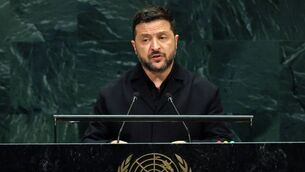
Health body agrees to speed up bird flu monitoring system

The 192-nation World Health Assembly today agreed to speed up preparations for a possible bird flu pandemic by allowing the UN health agency and member countries to establish a global warning system a year early.

Health body agrees to speed up bird flu monitoring system

The 192-nation World Health Assembly today agreed to speed up preparations for a possible bird flu pandemic by allowing the UN health agency and member countries to establish a global warning system a year early.

The chief decision-making body for the World Health Organisation approved without debate a resolution allowing for countries to immediately introduce a fast reporting system to guard against the start of a possible flu pandemic.

The resolution, which said a key element of the system is the “prompt notification to WHO of human influenza cause by a new virus subtype,” also urged WHO to make sure a system is in place to co-ordinate response to disease outbreaks and have a list of experts ready for rapid deployment.

The bird flu warning system, originally foreseen in a new version of the International Health Regulations approved by WHO members last year, had been scheduled begin operating on June 15, 2007.

But the resolution said countries could formally introduce it immediately because there is a “serious risk to human health, including the possible emergence of a pandemic virus, arising from ongoing outbreaks in poultry of highly pathogenic avian influenza.”

It expressed concern that cases of bird flu continue to occur sporadically in humans and that the virus had spread through the migration of wild waterfowl to new areas and was predicted to spread further.

Dr Anders Nordstrom, who took over as acting WHO chief following the death of Director-General Lee Jong-wook on Monday, said the resolution gives further impetus to progress already made against bird flu.

“We expect now that we will be able to accelerate it even more,” said Nordstrom.

But he said both countries and WHO needed to employ more people in the effort and raise more money to pay for preparations.

“Money is not flowing fast enough,” Nordstrom said.

So far, WHO has received only ÂŁ5-6 million of its share of the ÂŁ1billion pledged for bird flu and pandemic preparedness by the international community at a January meeting in Beijing, Nordstrom said.

“We have commitments and firm pledges for another £10 million, but we are far from what is needed for WHO,” which he said was about £45 million for the immediate period.

A resolution urging polio-endemic countries Nigeria, Pakistan, India and Afghanistan to step up efforts to eliminate polio was also approved by the assembly.

The resolution urged polio-free countries to guard against a return of the disease and be ready to conduct large-scale rounds of immunisation.

WHO had aimed to eradicate polio by the end of last year, but suffered a setback after authorities in Nigeria’s mostly Muslim north ordered an immunisation boycott in 2003, claiming the vaccine was part of a US-led plot to render Muslims infertile or infect them with Aids.

Vaccination programs restarted in the country the next year, but the boycott led to a return of the virus to countries that had been free of it. A strain of the polio virus that originated in Nigeria cropped up as far away as Indonesia last year.

Some 1,889 people were infected with polio worldwide last year, 775 of them in Africa, mostly in Nigeria, according to WHO.

The target to eradicate polio is now the end of this year.

“There is a very strong commitment from the assembly to continue the eradication approach,” said Nordstrom.

“We have a big challenge in Nigeria right now,” he said, but added that there is “a strong commitment by the government to increase their efforts.”

More in this section

Cookie Policy Privacy Policy Brand Safety FAQ Help Contact Us Terms and Conditions

© Examiner Echo Group Limited