Suicide bomber kills at least 37 in Baghdad market
A suicide bomber and a huge car bomb ripped apart a market in Baghdad’s Sadr City Shiite slum shortly before dusk today, killing at least 37 and wounding 95.
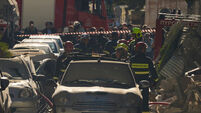
The death toll was sure to rise as residents, many firing Kalashnikov rifles into the air, raced to and fro to collect charred corpses from among burning vehicles and shops.
Angry residents kicked the head of the suicide bomber, an African, as it lay in the street of the Hay market in the east Baghdad neighbourhood.
Sirens wailed as ambulances raced to and from the scene. Smoke billowed into the air and fires continued to burn. Many shops were totally demolished by the huge explosions.
Police Lieutenant Thair Mahmoud said police were attempting to defuse a second explosives-laden car nearby.
On March 4, General John Abizaid, chief of the US Central Command predicted just such an attack by terrorists trying to spark an all-out civil war in the country.
“I expect we’ll see another attack in the near future on another symbol,” he said. “They’ll find some other place that’s undefended, they’ll strike it and they’ll hope for more sectarian violence,” the general said after a two-day visit to Baghdad.
He was speaking after the February 22 bombing of a Shiite shrine in Samarra that set in motion more than a week of sectarian violence in which hundreds were killed in revenge attacks. Dozens of Sunni mosques were damaged or destroyed.
“The shrine bombing exposed a lot of sectarian fissures that have been apparent for a while, but it was the first time I’ve seen it move in a direction that was unhelpful to the political process,” Abizaid said at the time. “It shows that we need a government of national unity to emerge in Iraq. Too many delays in the formation of a national unity government will negatively affect the security situation.”
US Ambassador Zalmay Khalilzad met for 90 minutes earlier today with leaders of all of Iraq’s many political factions. They emerged to announce the date for the first session of parliament had been moved up by three days to Thursday.
However, there was no sign of progress in overcoming the deep divisions among political leaders over forming the unity government to which Abizaid referred.
Before the deadly blast in Sadr City bomb blasts, rocket and gunfire killed at least 12 people – 10 in Baghdad – and wounded 27 today. The low thud of mortar fire rumbled over the city.
As the Iraqi work week resumed, a roadside bomb exploded in a busy west Baghdad street, killing at least six people and wounding 12, police said. The blast targeted a police patrol in a mostly Sunni area; three officers were among the dead and three were injured, police said. The other victims were civilian bystanders.
Another bomb targeting a police patrol near the Mustansiriyah University in east Baghdad wounded five officers, police said.
Drive-by shooters killed three occupants of a car in west Baghdad, including a member of President Jalal Talabani’s Patriotic Union of Kurdistan party, police said. Another carload of gunmen fired into a crowd of day labourers in another troubled west Baghdad neighbourhood, wounding four of them, police said. And a rocket landed near a house, killing one occupant and injuring two others.
In Mahmoudiya, about 20 miles south of Baghdad, gunmen ambushed and killed a police major as he headed to work, police said.
And in Baquoba, 35 miles north-east of Baghdad, a roadside bomb hit a police convoy, killing one patrolman and wounding four others, police said.
CONNECT WITH US TODAY



Be the first to know the latest news and updates