Children killed in Gaza missile strike

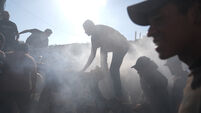
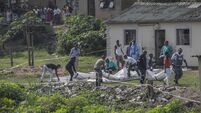
An Israeli missile that destroyed a vehicle in Gaza City killed three children as well as two Palestinian militants.

Children killed in Gaza missile strike

An Israeli missile that destroyed a vehicle in Gaza City killed three children as well as two Palestinian militants.

Two of the children were stepbrothers, aged 8 and 16, victims of an Israeli attack method that is attracting criticism in Israel as well as grief and rage in Gaza.

Israel’s air force commander defended the strike, on Monday, but two popular Israeli comedians said that an army that kills children no longer represents them, and a human rights group demanded a war crimes inquiry.

In recent months Israel has stepped up its airstrikes in Gaza, aimed at militants it says are involved in daily rocket barrages at Israel. Civilians are often caught in the crossfire.

The boys’ mother says it is too late for apologies.

Somaya al-Batsh, 29, mother of eight-year-old Raed and stepmother of 16-year-old Mahmoud, said: “I ran to the window when I heard the strike. The window shattered and I saw a man carrying Mahmoud’s lifeless body,

“But I couldn’t see Raed. I asked everyone: 'Where is Raed? Where is Raed?' A neighbour later told me that he flew through the air from the force of the blast.”

Receiving condolence callers in a tiny children’s room in the rundown Shajaiyeh neighbourhood of Gaza City, Mrs al-Batsh did not try to mask her anger at Israel.

Dressed in black with only her eyes showing through her full veil, she sat on the bed of her dead son. She said bitterly: “This was a street full of people and children. How can they fire a missile?

"Who is the terrorist here?”

Then she added: “My sons are in heaven now.”

The small room was decorated with the dead eight-year-old’s drawings: a winter scene and their grey, unpainted house.

Raed was the studious type, she said, and was already saving to buy a house. His red piggy bank rested near his bed, close to pictures of leaders of the militant group Hamas.

Mahmoud was a handyman, and kept people laughing around the house, she said. He picked fights with his sisters and cracked jokes about their living conditions.

Another 14-year old boy, Ahmed Sweisi, was killed in the strike. He was dumping rubbish at a street corner when the missiles struck.

Air force commander Eliezer Shkedy said this is the sort of thing that happens in wartime. Civilians get in the way.

He offered statistics showing that the air force is getting better at this. In 2002, as many bystanders were killed in the air strikes as terror suspects. Last year, he said, 28 militants were killed for every civilian in the raids.

Reflecting growing concern about air strikes in crowded cities, Shai and Dror, a two-man team of Israeli satirists who broadcast daily on a Tel Aviv radio station and write a column in the Maariv newspaper, said the air force commander’s explanation “does not clear our conscience”.

They wrote that they had a large circle of friends who felt the same way they did, but they would not say so in public, “because the Israeli narrative does not allow people to come out against the military…

"It is forbidden to say that this army does not represent me. But it doesn’t. Not when it kills children”.

In July 2002, the air force targeted Hamas commander Salah Shehadeh. A plane dropped a one-tonne bomb on his house in Gaza City, killing him and 14 other people, including nine children.

That set off an international outcry that has yet to subside. Israeli military officers involved in the bombing have been threatened with arrest when they travel abroad, and two have had to cancel trips as a result.

The Israeli human rights group B’Tselem is calling for the military to investigate whether the Monday raid involved the use of “disproportionate” force, “which is defined as a war crime”.

More in this section

Cookie Policy Privacy Policy Brand Safety FAQ Help Contact Us Terms and Conditions

© Examiner Echo Group Limited