Two killed in Baghdad car bomb attack
A suicide car bomb exploded outside a children’s hospital in western Baghdad today, killing at least two people and wounding 11 including seven policemen.
Police believe the bomb had been targeting a passing convoy carrying a police colonel who was among the injured.
In western Baghdad, gunmen attacked the convoy of the city’s Deputy Governor Ziad Tariq, killing three civilians and wounding three of Tariq’s bodyguards, Baghdad police said. Tariq was not injured.
A string of violent attacks, including shootings and bombings, began on Saturday night, shattering the relative calm since Iraq’s parliamentary election last week.
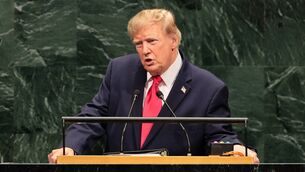
In a speech yesterday, US President George Bush praised the vote and warned against a pullout of US forces.
Hours before Bush spoke, US Vice President Dick Cheney made a surprise visit to Baghdad, saying the election’s strong turnout had brought Iraq closer to taking control of its own security. But Cheney also cautioned against a rapid US withdrawal.
Bush said last week’s voting would not end violence in Iraq but “means that America has an ally of growing strength in the fight against terror.”
He warned that a US troop pullout would “signal to the world that America cannot be trusted to keep its word”.
“We would hand Iraq over to enemies who have pledged to attack us, and the global terrorist movement would be emboldened and more dangerous than ever before,” he said.
The German government, meanwhile, yesterday said that kidnappers had freed a German woman taken hostage with her driver in northern Iraq more than three weeks ago. Susanne Osthoff, a 43-year-old aid worker and archaeologist, was reported in good condition in the care of the German Embassy in Baghdad.
It was unclear whether Osthoff’s Iraqi driver had also been freed.
Osthoff and driver disappeared on November 25. Days later, the two were shown in a videotape blindfolded and sitting on a floor, with militants – one armed with a rocket-propelled grenade – standing beside them.
The captors threatened to kill them unless Germany stopped dealing with the Iraqi government.
While Germany strongly opposed the US-led invasion of Iraq and refused to send troops here, it does train Iraqi soldiers and police outside the country.
In other violence today, gunmen opened fire on a bus carrying university students in central Baghdad, injuring two, police said, while in the south of the capital, 12 gunmen in three cars attacked a police checkpoint with rocket-propelled grenades. Two police and two civilians were injured, Capt. Haqi Mgotir of the Interior Ministry said.
Iraqi authorities were still counting ballots from Thursday’s election that will determine the allocation of parliament’s 275 seats for a four-year term.
Election official Safwat Rashid said the commission had so far received 345 complaints about the election, more than half claiming violations of campaigning rules. Other complaints were about names missing from voter rolls and some alleged interference with voters by party officials, police or election workers.
The commission began examining complaints yesterday. “Some of the complaints are minor and others may be grave enough to cancel the results of a ballot box,” Rashid said.
The complaints have to be dealt with before election results are released, a process that officials have said would take about 10 days.
The big election turnout – particularly among Sunni Arabs who boycotted the vote for an interim legislature on January 30 – raised expectations that increased political participation may undermine the Sunni-led insurgency and allow US troops to begin pulling out next year.
But Cheney, during his visit to Baghdad, stressed the Bush administration did not plan a rapid withdrawal.
“You’ve heard some prominent voices advocating a sudden withdrawal of our forces from Iraq,” he told hundreds of troops. “Some have suggested that the war is not winnable, and a few seem almost eager to conclude the struggle is already over. But they are wrong. The only way to lose this fight is to quit, and that is not an option.”
Prime Minister Ibrahim al-Jaafari told Cheney that he estimated 70 percent of Iraq’s 15 million registered voters went to the polls.
“The year 2005 is the most important in the history of Iraq in terms of productivity, of the establishment of the democratic process, the establishment of the constitution, the establishment of the Iraqi parliament,” he said.
Shiite Arabs account for about 60 percent of Iraq’s estimated 27 million people, compared with 20 percent for Sunni Arabs and a similar proportion for Kurds. Shiite and Sunni political leaders have said they likely will have to form a coalition Cabinet to govern.
At least one hard-line Sunni Arab politician, Saleh al-Mutlaq, said the turnout was a sign that insurgents were ready to participate in the political process.
“By abiding to its promise not to attack the voting process, the resistance has proved that it is ready to lay down its arms if the dialogue and democratic process is genuine,” said al-Mutlaq, who heads the Iraqi Front for National Dialogue.