Iran defiant on nuclear enrichment fears
The US and European nations whose diplomatic advances were rebuffed by Iran worked yesterday to present a case against the Tehran regime to the UN nuclear watchdog agency meeting this week.
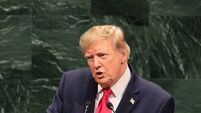
In a fiery speech to the UN General Assembly, Iranian President Mahmoud Ahmadinejad defiantly rejected the European offer of economic incentives in exchange for Iran giving up its uranium enrichment program.
Ahmadinejad denied his nation had any intention of producing nuclear weapons. To prove that, he offered foreign countries and companies a role in Iran’s nuclear energy production.
It is not clear what effect Ahmadinejad’s remarks will have on the International Atomic Energy Agency, whose member nations were lobbied heavily by the Bush administration ahead of a meting beginning Monday in Vienna.
The US accuses Iran of hiding nuclear weapons ambitions behind its civilian nuclear energy program, and wants the United Nations Security Council to review Iran’s record. The Security Council could impose punitive sanctions.
The European Union and US insist Iran halt a uranium conversion process restarted last month or face an effort to have UN punitive sanctions imposed. Conversion is a precursor step to uranium enrichment, which produces material that can be used as fuel for nuclear reactors to generate electricity but also as the core of nuclear weapons.
Privately, diplomats acknowledged yesterday what US President George Bush hinted at in remarks at the White House Friday: there is little or no chance that the IAEA will agree to take swift action against Tehran. The IAEA put off harsh action against Iran at its last meeting and seems likely to do the same this time.
Although the three European nations that negotiated with Iran now largely agree with the US that Iran should be referred to the Security Council, at least three powerful allies of Iran fought the plan.
Russia, China and India all have oil or other economic ties with Tehran, and Russia and China, as permanent members of the Security Council, could veto any sanctions.
Rather than force a vote it might lose, the Bush administration is reassessing its options.
After the US-European meeting, a State Department official gave no details of the discussions but said the four nations will present their views at the IAEA meeting.
Iran said yesterday that it has no plans to resume uranium enrichment soon, but warned that it might change its mind if the IAEA were to ask the Security Council to consider sanctions.
“Enrichment is not on the agenda for the time being, but if the IAEA meeting on Monday leads to radical results, we will make our decision to correspond to that,” Foreign Ministry spokesman Hamid Reza Asefi said.
“In a radical atmosphere, there is the possibility of any decision” by Iran’s leaders, he added, without elaborating.