New Orleans disaster likened to tsunami and Hiroshima
Rescuers along the hurricane-ravaged Gulf Coast pushed aside the dead to reach the living in a race against time and rising waters, while New Orleans sank deeper into crisis and Louisiana’s governor ordered storm refugees out of this drowning city.
Two levees broke yesterday and sent water coursing into the streets of the Big Easy a full day after New Orleans appeared to have escaped widespread destruction from Hurricane Katrina.
An estimated 80% of the below-sea-level city was under water, up to 20 feet deep in places, with miles and miles of homes swamped.
One Mississippi county alone said its death toll was at least 100, and officials are “very, very worried that this is going to go a lot higher,” said Joe Spraggins, civil defence director for Harrison County, home to Biloxi and Gulfport.
Thirty of the victims in the county were from a beachfront apartment building that collapsed under a 25-foot wall of water as Katrina slammed the Gulf Coast with 145-mph winds. And Louisiana officials said many were feared dead there, too, making Katrina one of the most punishing storms to hit the US in decades.
After touring the destruction by air, Mississippi Gov. Haley Barbour said it is not of case of homes being severely damaged, “they’re simply not there. … I can only imagine that this is what Hiroshima looked like 60 years ago.”
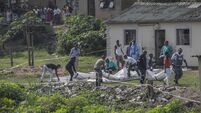
New Orleans Mayor Ray Nagin said hundreds, if not thousands, of people may still be stuck on roofs and in attics, and so rescue boats were bypassing the dead.
“We’re not even dealing with dead bodies,” Nagin said. ”They’re just pushing them on the side.”
The flooding in New Orleans grew worse by the minute, prompting the evacuation of hotels and hospitals and an audacious plan to drop huge sandbags from helicopters to close up one of the breached levees.
At the same time, looting broke out in some neighbourhoods, the sweltering city of 480,000 had no drinkable water, and the electricity could be out for weeks.
With water rising perilously inside the Superdome, tens of thousands of refugees now huddled there and other shelters in New Orleans would have to be evacuated.
A helicopter view of the devastation over the New Orleans area revealed people standing on black rooftops baking in the sunshine while waiting fr rescue boats.
A row of desperately needed ambulances were lined up on the interstate, water blocking their path. Roller coasters jutted out from the water at a Six Flags amusement park. Hundreds of inmates were seen standing on a highway because the prison had been flooded.
All day long, rescuers in boats and helicopters pulled out shellshocked and bedraggled flood refugees from rooftops and attics. The Coast Guard said it has rescued 1,200 people by boat and air, some placed shivering and wet into helicopter baskets.
They were brought by the truckload into shelters, some in wheelchairs and some carrying babies, with stories of survival and of those who didn’t make it.
Across Louisiana, Mississippi and Alabama, more than one million residents remained without electricity, some without clean drinking water. An untold number who heeded evacuation orders were displaced and 40,000 were in Red Cross shelters, with officials saying it could be weeks, if not months, before most will be able to return.
Emergency medical teams from across the country were sent into the region and President George Bush cut short his Texas vacation yesterday to return to Washington to focus on the storm damage.
Federal Emergency Management Agency director Mike Brown warned that structural damage to homes, diseases from animal carcasses and chemicals in floodwaters made it unsafe for residents to come home anytime soon. And a mass return also was discouraged to keep from interfering with rescue and recovery efforts.
That was made tough enough by the vast expanse of floodwaters in coastal areas that took an eight-hour pounding from Katrina’s howling winds and up to 15 inches of rainfall.
From the air, neighbourhood after neighbourhood looked like nothing but islands of rooftops surrounded by swirling, tea-coloured water.
In New Orleans, the flooding actually got worse yesterday. Failed pumps and levees apparently spilled water from Lake Pontchartrain into streets. The rising water forced hotels to evacuate, led a hospital to boatlift patients to emergency shelters, and drove the staff of New Orleans’ Times-Picayune newspaper out of its offices.
In devastated Biloxi, Mississippi, areas that were not underwater were littered with tree trunks, downed power lines and chunks of broken concrete. Some buildings were flattened.
The string of floating barge casinos crucial to the coastal economy were a shambles. At least three of them were picked up by the storm surge and carried inland, their barnacle-covered hulls sitting up to 200 yards inland.
The deadliest spot yet appeared to be Biloxi’s Quiet Water Beach apartments, where authorities said about 30 people were washed away. All that was left of the red-brick building was a concrete slab.
Said Biloxi Mayor A. J. Holloway: “This is our tsunami.”
Looting became a problem in both Biloxi and in New Orleans, in some cases in full view of police and National Guardsmen. One police officer was shot in the head by a looter in New Orleans, but was expected to recover, Sgt. Paul Accardo, a police spokesman.
On New Orleans’ Canal Street, which actually resembled a canal, dozens of looters ripped open the steel gates on clothing and jewellery stores, some packing plastic garbage cans with loot to float down the street.
One man, who had about 10 pairs of jeans draped over his left arm, was asked if he was salvaging things from his store.
“No,” the man shouted, “that’s everybody's store!”
Looters at a Wal-Mart brazenly loaded up shopping carts with items including microwaves, coolers and knife sets. Others walked out of a sporting goods store on Canal Street with armfuls of shoes and football jerseys.
Outside the broken shells of Biloxi’s casinos, people picked through slot machines to see if they still contained coins and ransacked other businesses.
“People are just casually walking in and filling up garbage bags and walking off like they’re Santa Claus,” said Marty Desei, owner of a Super 8 motel.
Insurance experts estimated the storm will result in up to $25bn (€20.5bn) in insured losses. That means Katrina could prove more costly than record-setting Hurricane Andrew in 1992, which caused an inflation-adjusted $21bn (€17.2bn) in losses.
Oil prices jumped by more than $3 a barrel yesterday, climbing above $70 a barrel, amid uncertainty about the extent of the damage to the Gulf region’s refineries and drilling platforms.
CONNECT WITH US TODAY



Be the first to know the latest news and updates