Al-Qaida claims responsibility for Allawi attack
An al-Qaida suicide driver detonated a car bomb at a guard post outside the Iraqi prime minister’s party headquarters in Baghdad today, injuring at least 10 people.
Terror mastermind Osama bin Laden’s affiliate group in Iraq claimed responsibility a day after its leader declared all-out war on democracy.
Later, mortar rounds slammed into an Iraqi National Guard camp near Baghdad International Airport and the rumble of distant explosions reverberated through the capital. There was no report of casualties in the mortar attack.
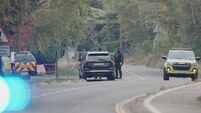
The suicide bomber struck at a police checkpoint on the road leading to Ayad Allawi’s Iraqi National Accord offices in central Baghdad, shaking the city centre with a thunderous explosion. Among the wounded were eight policemen and two civilians, said Dr Mudhar Abdul-Hussein of Yarmouk Hospital.
Al-Qaida’s wing in Iraq said in an internet posting that “one of the young lions in the suicide regiment” carried out the attack against the party office of Allawi, “the agent of the Jews and the Christians".
The attacks occurred six days before Iraq’s crucial national elections, the first since the fall of Saddam Hussein in 2003. Insurgents have condemned the elections and vowed to disrupt them.
The suicide attack rattled buildings along the Tigris River in the centre of the city and sent black smoke rising above the skyline. US military helicopters cut through overcast skies above the scene.
Iraqi police fired on the car as it sped toward them, killing the driver as the blast ripped the vehicle apart, said an Interior Ministry official.
Splintered police vehicles were engulfed in flames, and gunfire rattled after the explosion.
Earlier this month, a suicide car bomber targeted the same checkpoint outside the offices of Allawi’s party, killing four people and injuring 25.
Iraqi police had moved the roadblock of barbed wire and metal traffic barriers further away from Allawi’s office after that attack.
The site is not far from Baghdad’s Green Zone, the heavily fortified compound that houses the US Embassy and the offices of the Iraqi interim government. Insurgents have frequently targeted the district with mortar fire and car bombs.
In an audiotape posted on the web yesterday, a speaker claiming to be Abu Musab al-Zarqawi, head of al-Qaida in Iraq, declared “fierce war” on democracy and said anyone who takes part in next weekend’s Iraqi elections would be considered “an infidel".
“We have declared a fierce war on this evil principle of democracy and those who follow this wrong ideology,” the speaker said. “Anyone who tries to help set up this system is part of it.”
The speaker warned Iraqis to be careful of “the enemy’s plan to implement so-called democracy in your country". He said the Americans have engineered the election to install Shiite Muslims in power. Al-Zarqawi, who is a Sunni Arab like most of the insurgents here, has in the past branded Shiites as heretics.
The United States has offered a €18.7m reward for al-Zarqawi’s capture or death – the same amount as for al-Qaida leader in Laden.
Iraqi security forces arrested a man authorities described as the chief of al-Zarqawi’s propaganda operations, said Thaer al-Naqib, a spokesman for the prime minister.
The US ambassador to Iraq acknowledged there were serious security problems ahead of this weekend’s landmark election, in which Iraqis will choose a national legislature that will run the country and draft a permanent constitution.
Legislatures in 18 provinces and a regional parliament in the Kurdish-run areas of the north will also be elected.
American and Iraqi officials have warned they expect rebels to unleash bloodshed and mayhem to keep voters from the polls in what supporters are advertising as the first free election in this country since the overthrow of Iraq’s monarchy in 1958.
Ambassador John Negroponte said serious security problems remain in the Sunni Triangle north and west of Baghdad.
“There will be some problematic areas. ... But even there, great efforts are being made to enable every Iraqi eligible to do so to be able to vote,” he said.
CONNECT WITH US TODAY



Be the first to know the latest news and updates