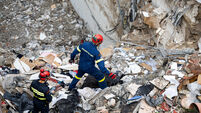
Death toll passes 150,000 in tsunami disaster
The official death toll in the Asian tsunami disaster today climbed past 150,000 as Indonesian authorities increased their tally by nearly 3,000 while adding tens of thousands to their count of the number left homeless from the disaster.
Officials expect the toll to rise further still.
Indonesia’s toll has risen sharply in recent days as teams of rescuers recover corpses from remote regions near the epicentre of the quake that spawned a tsunami affecting 11 countries in Africa and Asia.
Aid workers struggled today to reach the survivors – and provide for their needs. Staggered by the scale of the disaster, aid officials described plans to feed as many as two million survivors a day for six months.
“I must say, the World Food Programme is in the disaster response business ... and this truly is the most extraordinary physical natural disaster I have ever seen,” World Food Programme Executive Director James Morris told reporters after viewing the battered coast.
“The damage is overwhelming, the loss of property, the loss of life, injury to people and the risk going forward is enormous.”
The increase in number of dead came even as authorities held out little hope for the tens of thousands still missing.
Officials in Sri Lanka and Thailand, which were also hard-hit by the killer waves, say thousands were unlikely to be found alive.
Sweden, Britain and France have warned they feared that nearly 1,100 of their citizens missing in the disaster were dead.
Nearly two weeks after huge waves struck, the lists of missing were still rising. Sri Lanka, with more than 30,000 known dead, added 528 names to its ranks of missing on Friday, for a total of 4,984. Indonesia, the worst hit country, estimates 104,055 dead and just over 10,000 missing.
Aid groups complained that dignitaries flying in to visit the tsunami-devastated coast in recent days have choked the region’s tiny main airport and hampered relief supplies.
Visits by UN Secretary General Kofi Annan and US Secretary of State Colin Powell have shut provincial capital Banda Aceh’s only airport temporarily for security reasons. That has clogged incoming shipments.
“It slows things down,” said Maj. Murad Khan, a spokesman for Pakistan’s Tsunami Relief Task Force.
A delegation of American senators and representatives was arriving to see Banda Aceh later today. They came by helicopter from the USS Abraham Lincoln aircraft carrier so they would not disrupt other flights.
In Sri Lanka, Annan toured a town today where hundreds of shoppers at an outdoor weekly market were swept to their deaths, but reluctantly agreed to a Sri Lankan request not to visit disaster-stricken areas controlled by Tamil Tiger rebels.
UN officials said Annan would have liked to assess the damage and speak to the people of the battered northeastern coast, where thousands of Tamils were killed and many more lost their homes and livelihoods.
“I’m here on a humanitarian visit. I’m concerned about everyone with need in the humanitarian situation,” Annan said when asked if he would go to the rebel-held north. ”But I’m also a guest of the government, and we’ll go where we agreed we’ll go.”
Accompanied by the head of the World Bank, James A. Wolfensohn, and top UN officials, Annan inspected the battered southern and eastern coastlines which took the brunt of the tsunami’s impact.
The Tigers, who have fought a 20-year war for Tamil independence from the Sinhalese-dominated south, invited Annan to tour the northern province. But government officials speaking on condition of anonymity said they could not guarantee Annan’s safety there.
UN officials said they regretted the visit had become a political issue.
Survivors of the calamity struggled to put their lives back together. Around the devastated Indonesian town of Lhok Nga, convoys of trucks were dumping debris and rubble from the town in a previously upscale neighbourhood and soldiers continued to pick through the wreckage hunting for bodies. An elephant also was helping move the debris.
Rice farmer Mohammad Amin, 45, was walking along the road with his wife and one of his daughters with sacks of rice and noodles on their heads – after travelling for three days on foot from their shattered village to pick up food. They said there was nowhere for relief helicopters to land in their village.
Near the road a huge barge, about the size of a football field, was lying on its side 150 meters (490 feet) from the coast. Close to it were tugs that apparently were pulling it when the wave struck.
Around the wrecked city of Banda Aceh, signs of normal life were visible again.
While large parts of the provincial capital are completely flattened and still smell of decomposing corpses, at a bustling market in the Lambaro section of town women haggled over the cost of chillies, bananas, chickens and goats. Barbers set up shop and old men sipped coffee in outdoor cafes.