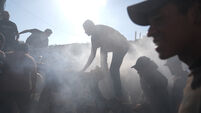
Train crash poison gas cloud : Eight dead, 240 injured
A US freight train carrying chlorine gas struck a parked train, killing eight people and injuring more than 240 others, nearly all of them sickened by a toxic cloud that persisted over this small textile town of Graniteville, South Carolina.
Authorities ordered all 5,400 people within a mile of the crash to evacuate in the afternoon because chlorine was continuing to leak and the gas was settling near the ground as temperatures dropped.
They were unsure when the gas leak might be sealed.
State Senator Tommy Moore said last night that officials at Avondale Mill, the textile plant where the crash happened, told him eight people were found dead following the accident, including five inside the mill.
Eight others were in critical condition Thursday night after the 2.30am wreck of Norfolk Southern trains, in which 16 cars derailed.
Moore said he was told all the deaths were caused by inhaling chlorine fumes, except for the engineer of the moving train, who died in the crash. Sheriff’s Lt Michael Frank said one person was found dead in a home and another was found in a vehicle. Autopsies were scheduled today.
Most of the injured were treated for respiratory ailments and released, but at least 45 people were admitted to hospitals, authorities said.
Residents were jarred awake yesterday by the sound of metal dragging and a house-shaking boom. A chemical fog lay over the crash site when Douglas Brown drove there after hearing the wreck from his home two streets away.
“You could smell it real good. It made your tongue numb, your throat get sore and your eyes get dry,” said Brown, 44, who was among those treated.
Authorities convinced all but about a dozen people in the area to evacuate, and set up shelters for evacuees. Gov. Mark Sanford declared a state of emergency for Aiken County.
Sixteen-year-old Natasia Grant was among about 70 people who had taken refuge at a shelter at the University of South Carolina-Aiken. She said the air still smelled like ”a pool, but stronger” more than 12 hours after the crash.
The potentially fatal gas can damage the respiratory and central nervous systems, and the throat, nose and eyes. Those who were exposed were told to report to decontamination units at two schools.