Stench of death hangs over luxury resorts

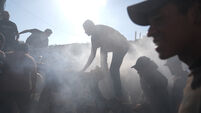
Soldiers used bulldozers today to push into a strip of Thai luxury resorts destroyed by tidal waves, and picked the bodies of European tourists from ruined gardens and hotel rooms.

Stench of death hangs over luxury resorts

Soldiers used bulldozers today to push into a strip of Thai luxury resorts destroyed by tidal waves, and picked the bodies of European tourists from ruined gardens and hotel rooms.

Officials said at least 700 foreigners had died, and the death toll could reach 2,000.

The stench of death hung over a 19 mile stretch of coast in the southern Phang Nga province, which had been packed with foreign tourists from more than 20 countries staying at international hotels such as the Le Meridien, Novotel and Sofitel.

Mud and debris left behind by tidal waves that struck on Sunday made parts of Phang Nga hard to reach immediately after the disaster, and bloated and rotting bodies remained littered along the shorefront as volunteer rescue crews and troops went about their work Tuesday.

Phang Nga and the nearby resort islands of Phuket and Phi Phi were worst hit by the waves, which killed 1,516 people and injured 8,432, according to the latest count. Of the dead, 950 were found in Phang Nga and 203 on Phuket.

Deputy Interior Minister Sutham Saengprathum said it was certain that more than 700 foreigners were among the dead, but the exact number was still not known.

Prime Minister Thaksin Shinawatra said the overall death toll could pass 2,000, given the large number of still missing people.

In Khao Lak on the mainland, some 200 bodies – about 70% of them foreigners - were laid at a makeshift morgue at the Buddhist Rasneramith temple, said volunteer Somsak Palawat.

Bloated, black and green corpses, many of them children and babies, were also scattered around the temple.

Near the devastated Similan Beach and Spa Resort, where some 60 mostly German tourists had been staying, the corpse of a naked man hung suspended from a tree as if crucified.

A police patrol boat lay beached more than half a mile from the sea.

At the nearby Sofitel, executive Ofwald Tichler declined to say how many of the hotel’s guests had died as waves smashed into the 319-room resort.

The first floors of the three-story, Thai-style building were destroyed, and thick mud caked the once beautifully landscaped area between the lobby and beach, a distance of 300 yards.

Several rotting bodies could be seen on the beach, under debris and in a pool of water in front of the hotel as Thai soldiers moved in to search for survivors and the dead.

“I lost my girlfriend. We saw the wave coming. It was so huge we had no time to run,” said Karl Kalteka of Munich, who was at the beach in front of the Sofitel when the first wave struck.

“I saw many kids perish. I saw parents trying to hold them but it was impossible. It was hell.”

Kalteka, who suffered numerous broken limbs and other injuries, spoke at Phuket airport where he lay in a stretcher. He still had hope his girlfriend was alive and they would be reunited in Bangkok.

The search operation around the Sofitel was temporarily suspended over fears that a nearby weapons arsenal at the Phang Nga Navy Base might explode.

A bomb expert said that missiles and mortar shells from the depot were swept out to sea when the base, was hit by waves. He said there was danger the mortar shells could explode but the missiles posed no danger.

Swedish tour operator Fritidsresor said 600 Swedes who were vacationing in Khao Lak were not accounted for.

Phang Nga Governor Anuwut Medhiwiboonwut said about 1,000 searchers, including army troops riding bulldozers, would move into four areas of the province that have been difficult to access because of flooding and thick mud crusts.

The governor said he expected about 400 bodies to be recovered today.

More in this section

Cookie Policy Privacy Policy Brand Safety FAQ Help Contact Us Terms and Conditions

© Examiner Echo Group Limited