Ukrainian parliament adopts changes
Ukraine’s parliament adopted electoral and constitutional changes today in a compromise intended to defuse the nation’s political crisis – prompting opposition leaders to say they would lift a blockade of government buildings.
The surprise vote came after more than two weeks of political manoeuvring and street protests. It suggested opposition leader Viktor Yushchenko’s camp had determined prolonged unrest could weaken the country and his own position ahead of the December 26 re-run of the presidential election – particularly in the mainly Russian speaking east of the country.
The package was approved in a 402-21 vote with 19 abstentions. MPs stood and cheered as outgoing President Leonid Kuchma signed the measure.
“Over the last 100 years, Ukraine has more than once suffered through a crisis, but there was always enough common sense to find a way out and a decision,” Kuchma said.
Under the changes, the president no longer has the power to appoint his own government, but keeps the right to reject parliamentary nominees for the top three positions – prime minister, foreign minister and defence minister. Parliament also earns the right to appoint all other Cabinet positions without presidential approval.
“This makes it impossible to have an authoritarian government in Ukraine,” said Mikhail Pogrebinsky, a Kiev-based political analyst with close ties to Kuchma. ”All those who wanted battles and war lost today.”
To prevent electoral fraud in the new ballot, restrictions will be placed on absentee voting.
Yushchenko supporters had pushed strongly for the electoral changes, but had resisted the constitutional reforms, fearing they would weaken the presidency by transferring some powers to parliament.
They had also called for the resignation of Prime Minister Viktor Yanukovych, who was declared the winner of the November 21 run-off which the Supreme Court later annulled. But Kuchma refused to fire him and he retained his post after the parliamentary session ended without taking any action on the issue.
Ukraine’s opposition planned to lift its blockades of government buildings at 7pm (5pm Irish time) today, Socialist Party leader Oleksandr Moroz said.
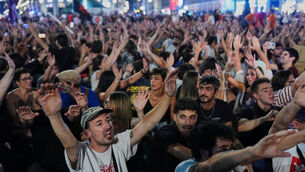
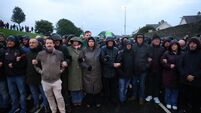
As word spread of the decision, demonstrators – exhausted and haggard after spending two weeks in the streets in freezing temperatures – expressed relief.
“Some kind of compromise had to be reached,” said Serhiy Vlasov, 44, who wore a pro-Yushchenko orange band tied around his arm. “We couldn’t drag this out forever.”
Campaigning in eastern Ukraine, Yanukovych said he was “not happy” with the parliament’s decision and described it as a “soft coup d’ etat.”
“All the decisions were made under pressure,” Yanukovych said.
After signing the text, Kuchma shook hands with parliament speaker Volodymyr Lytvyn and the deputy speakers. Lytvyn then clasped both blue leather folders embossed with a gold trident – a symbol of Ukraine – and held them up to show to deputies.
“We didn’t go beyond the limits and didn’t fall over the precipice,” Lytvyn said. “I hope that after this decision, the situation will stabilise in Ukraine.”
Lawmakers also began to reshuffle the Central Election Commission, voting 146-129 to oust its head, Serhiy Kivalov. A decision to nominate him again was met with shouts of “Shame!” by Yushchenko supporters.
“Today was the day for critical compromise,” a jubilant Yushchenko told reporters. “Tomorrow could have been too late.”
Yushchenko said Kuchma’s allies wanted to steal his potential victory on December 26 by weakening the presidency. A group of communist, socialist and pro-government factions in parliament agreed to the electoral changes on condition they were voted together with the constitutional changes.
Andriy Smalchuk, a 22-year-old opposition protester, welcomed the compromise, saying it was important to balance the powers of the presidency and parliament “because we don’t know who will come next after Yushchenko.”
In Brussels, US Secretary of State Colin Powell praised the parliamentary decision.
“Ukrainian and Russian authorities are hearing a clear message from North America and Europe, in diplomatic stereo – and that stereo sound makes a difference,” Powell said before a NATO meeting. “And what do we say? Let the people decide.”
The European Union’s foreign policy chief, Javier Solana, also congratulated “all sides on the crucial decisions that were taken today.”
The decision should “pave the way for a free and fair rerun,” Solana said in a letter.
Also today, the website of The Times reported that doctors in Austria who treated Yushchenko for a mysterious illness during the initial campaign had determined he had been poisoned, and that the intention was to kill him.
Dr. Michael Zimpfer, director of the hospital where Yushchenko was treated, said a combination of poisons could have caused the illness, but there was no conclusive evidence.
The doctor quoted by the newspaper, Dr. Nikolai Korpan, was not available for comment, but speaking to the Austria Press Agency, he denied making the comments.
Yushchenko fell ill on September 6 and was rushed to the Vienna clinic four days later. He has accused Ukrainian authorities of poisoning him but his detractors suggested he’d eaten some bad sushi.