Three dead as Charley slams into Florida coast
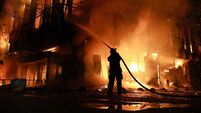
Hurricane Charley struck west-central Florida with a mix of wind and water, ravaging oceanfront homes and trailer parks, tearing apart small planes and inundating the coast before moving inland to assault Orlando and Daytona Beach.
The Category 4 storm was stronger than expected when the eye reached the mainland yesterday afternoon at Charlotte Harbour, pummelling the coast with winds reaching 145mph and a surge of sea water up to 15 feet.
Three people died during the storm and dozens were injured. More than 500,000 customers were without power.
Earlier, Charley had been blamed for three deaths in Cuba and one in Jamaica.
President George Bush declared a major disaster area in Florida. His brother, Florida governor Jeb Bush, projected damage from Charley could exceed €13bn.
Damage was especially heavy in downtown Punta Gorda on Charlotte Harbour.
“It looks like a war zone – power lines down everywhere, street signs, pieces of roofs blown off, huge trees uprooted,” said Buddy Martin, managing editor of the Charlotte Sun.
Martin said he saw homes ripped apart at two trailer parks. “There were four or five overturned semi trucks – 18-wheelers – on the side of the road.”
Extensive damage was also reported on exclusive Captiva Island, a narrow strip of sand west of Fort Myers.
The hurricane rapidly gained strength in the Gulf of Mexico after crossing Cuba and swinging around the Florida Keys as a more moderate Category 2 storm yesterday morning. An estimated 1.4 million people evacuated in anticipation of the strongest hurricane to strike Florida since Andrew in 1992.
Charley reached landfall at 3.45pm local time (8.45pm Irish time), when the eye passed over barrier islands off Fort Myers and Punta Gorda, some 110 miles south east of the Tampa Bay area.
Wayne Sallade, director of emergency management in Charlotte County, was angry that forecasters underestimated the intensity of the storm until shortly before landfall.
“They told us for years they don’t forecast hurricane intensity well, and unfortunately we know that now,” he said. “This magnitude storm was never predicted.”
The president’s declaration made government money available to Charlotte, Lee, Manatee and Sarasota counties. “Our prayers are with you and your families tonight,” Bush said from Seattle.
A crash on Interstate 75 in Sarasota County killed one person, and a wind gust caused a truck to collide with a car in Orange County, killing a young girl. A man who stepped outside his house to smoke a cigarette died when a banyan tree fell on him in Fort Myers, authorities said.
The eye of the hurricane passed directly over Punta Gorda, a city of 15,000. At the county airport, wind tore apart small planes, and one flew down the runway as if it were taking off. The storm spun a parked pick-up truck 180 degrees, blew the windows out of a sheriff’s deputy’s car and ripped the roof off a building.
At Charlotte Regional Medical Centre in Punta Gorda, up to 50 people came in with storm injuries. The hospital was so badly damaged that patients were being transferred to other hospitals on coastguard helicopters.
“There’s a lot of crush injuries,” hospital CEO Josh Putter said. “Things have fallen on people, crushed their legs, crushed their pelvis – a lot of bleeding.”
In Arcadia, 20 miles inland, the roof blew off at a civic centre serving as a shelter for 1,200 people. At least one person suffered minor injuries.
The roof “started peeling back,” said Alida Dejongh. ”It lifted and you could just see more and more light. You could hear this popping and zipping noise like a giant Ziploc bag.”
Charley was forecast to strike Daytona Beach area before reaching the Atlantic Ocean, where it could regain strength. Rain totalling four to eight inches was expected along Charley’s path, creating the risk of flash flooding.