Bush criticised over NI peace policy
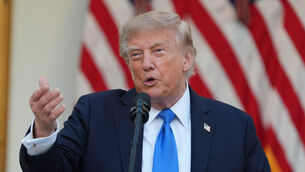
US President George Bush has been attacked by his main Democratic rival for pushing the Northern Ireland peace process down the White House’s foreign policy agenda.
In a comprehensive statement on the peace process circulated in recent weeks to Irish American groups, Democratic presidential hopeful Senator John Kerry criticised the rev Ian Paisley’s Democratic Unionists for “refusing to form a government with Sinn Féin”.
He also urged the IRA and loyalists to get rid of all their weapons and end all paramilitary activity.
Senator Kerry, who has already won 14 of the 16 state primaries for his party’s nomination for this November’s election and is expected to win another tonight in Wisconsin, accused the Bush administration of failing to build on Bill Clinton’s efforts to promote the peace process when he was in the White House.
The Massachusetts senator’s campaign team said: “John Kerry will put the Northern Ireland peace process high on America’s foreign policy agenda.
“On this issue, he will continue to follow the path set by Senator (Edward) Kennedy, President Clinton and Senator (George) Mitchell.
“John Kerry believes that President Bush has failed to recognise the importance of building on the work of President Clinton in facilitating the peace process.
“There was not a US Ambassador in Ireland in more than a year. President Bush’s lack of urgency in naming a new Ambassador to Ireland and the absence of Presidential involvement in efforts to further the peace process are clear evidence that Ireland is not a high priority for the Bush administration.”
During his four-year term, President Bush has had two advisers on Northern Ireland – former State Department official Ambassador Richard Haass and his recently appointed successor, Ambassador Mitchell Reiss.
Ambassador Haass paid several visits to the North to urge political leaders to reach agreement on power sharing and support IRA disarmament.
He also supported police reform in the North and the integrated education of Protestant and Catholic schoolchildren.
Last April, President Bush met politicians during a visit to Northern Ireland and issued a joint statement with British Prime Minister Tony Blair and the Taoiseach Bertie Ahern urging the North to consign paramilitarism to history.
However the primary purpose of the visit was a summit at Hillsborough Castle with Mr Blair on the Iraq war.
President Bush has also regularly held St Patrick’s Day receptions for Mr Ahern and Northern Ireland’s leaders in the White House, although they have been more muted than the Clinton administration’s.
Senator Kerry said there had been many positive developments in Northern Ireland since the Good Friday Agreement in 1998, with a marked reduction in sectarian killings, devolution, the scaling down of the British army presence, a start to IRA disarmament, and the setting up of cross-border and British-Irish institutions.
His statement welcomed the new police service which he hoped would “soon command the support of everyone in Northern Ireland”.
However the presidential hopeful acknowledged that more work needed to be done.
His campaign team said: “As a supporter of the need to hold recent elections for the Northern Ireland Assembly, he believes that repeatedly suspending democratic institutions is not the way forward for Northern Ireland.
“He urges all parties involved to work for the earliest resumption of the Assembly. And he believes the review of the Belfast Agreement must be just that - – a review, not a renegotiation.
“The problem is not the structures of the Agreement itself, but rather the failure of all to fully implement it.
“The DUP cannot be permitted to disenfranchise half the population of Northern Ireland by refusing to form a government with Sinn Féin.”
Senator Kerry said the full implementation of the Agreement could not be put on hold during the review at Stormont.
Further action was needed, he said, on the scaling down of security in the North and on human rights.
“It is equally important that the IRA take further substantive measures of decommissioning,” he said.
“The guns are silent, which is a positive step but the guns must be removed forever and an end must come to all paramilitary activity – both republican and loyalist.”
Senator Kerry’s statement paid tribute to the role of the Irish community in the United States and noted that his own country had also played its part in building peace and in the creation of the Republic’s Celtic Tiger economy.
Economic ties between the two countries meant Irish companies were also a large investor in the US, creating more than 100,000 jobs, he said.
Political stability in Northern Ireland could only strengthen economic links between the North, the Republic and the US, he said.
“John Kerry’s administration will support these growing business ties which bring economic benefits to all,” his campaign team pledged.
Arguing that Ireland served as “an important bridge between the United States and the European Union”, the Massachusetts senator also said he would work with the Irish government to repair American ties with Europe “which were greatly damaged in President Bush’s handling of the situation in Iraq”.
A republican congressman is due to visit Belfast tomorrow for talks with political leaders.
New York Congressman Jim Walsh is due to travel to the North to meet Sinn Féin and other parties taking part in the review of the Good Friday Agreement.
Sinn Féin president Gerry Adams is due to march in a St Patrick’s day parade in Congressman Walsh’s home town of Syracuse next month.

CONNECT WITH US TODAY



Be the first to know the latest news and updates