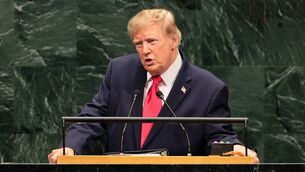
US facing tough time in getting Iraq aid
The United States faces tough negotiations on its proposed UN resolution that seeks troops and money from all nations for Iraq’s post-war reconstruction but does not relinquish political or military control.
France, which led opposition to the war on Iraq, has made clear that if the United States wants to share the burden of restoring peace to Iraq, it must share information, authority, and decision-making.
France, Germany, Russia are also seeking a much larger UN role in Iraq and the speedy restoration of Iraqi sovereignty to bring peace to the country – a demand reiterated today by Russia's Foreign Ministry.
Reaching out to the international community for help, and acknowledging for the first time that international support is “essential” to restore stability and security to Iraq, the Bush administration last night offered the United Nations a bigger role in Iraq’s security, political transition and reconstruction.
But whether it is big enough to satisfy members of the Security Council remains to be seen.
The draft resolution would transform the US led military force in Iraq into a UN authorised multinational force under a unified command.
It would also ask the Iraqi Governing Council to cooperate with the United Nations and US officials in Baghdad to produce a timetable and programme for drafting a new constitution and holding democratic elections.
But Secretary of State Colin Powell, who outlined the proposal, made clear that “the United States will continue to play a dominant role” both politically and militarily.
An American commander will take charge of the multinational force and US civilian administrator Paul Bremer will keep the top political post, he said.
To council nations that want responsibilities in Iraq to be shared, Powell said, “With the resolution, you’re essentially putting the Security Council into the game.”
“I would expect by the end of the week … I will have received indications from my Security Council colleagues with respect to their reaction to the resolution and what suggestions they might have,” Powell said.
“We will see where we are at the beginning of next week and push it as aggressively as we can.”
Powell said he did not foresee “an extended process” of negotiations. Other council diplomats said they would like the resolution to be adopted before ministers gather for the meeting of the UN General Assembly on September 23.
Some European countries are likely to resist, or protest, if the United States continues to try to hold on to all the lucrative and influential ventures – such as oil contracts and the political rebuilding process, according to some council diplomats.
They expect France to take the toughest position, pressing for the United Nations to take charge of Iraq’s political transition – though Paris is unlikely to achieve that degree of power for the world body.
The post-war operation is costing the United States about €36bn a month, and has strained the American military, which has 140,000 troops stationed in Iraq.
CONNECT WITH US TODAY



Be the first to know the latest news and updates