Road map in crisis as 24 die in violence
The US-backed road map to peace in the Middle East was in crisis tonight after a suicide bomber killed at least 17 on a Jerusalem bus and seven Palestinians were killed by Israeli air strikes in Gaza City.
Seventy people were wounded in the Jerusalem bombing, the deadliest in three months, and 30 were hurt in the Gaza missile attack.
The violence was a major setback for US President George Bush, who only last Wednesday launched his peace plan aimed at ending the violence and creating a Palestinian state by 2005.
The Israeli Prime Minister Ariel Sharon and his Palestinian counterpart Mahmoud Abbas had pledged to support the plan at a landmark three-way summit with the US president in Jordan.
The suicide bombing in central Jerusalem also underscored Israel’s vulnerability and the ineffectiveness of Palestinian efforts to persuade the militants to give up terrorism.
The bus bombing came a day after Israeli helicopters attacked a car carrying Abdel Aziz Rantisi, a top political leader of the Hamas militant group. He survived with minor injuries and two bystanders were killed.
Hamas had threatened bloody revenge, and today Rantisi said the bus bombing was “an answer” to Sharon, CNN reported. A Hamas website later said the group claimed responsibility for the attack.
The Palestinian Authority condemned the bombing, while Israel renewed a demand that Palestinian security forces immediately dismantle militant groups.
The blast shattered windows and tore a large hole into the left side of the red and white bus.
Jerusalem Police Chief Mickey Levy said: “We are talking about a big explosive device that was set off by a suicide bomber.”
Hagit Stein, who works at a shoe shop nearby, said she had just got off the bus before it blew up behind her.
“I didn’t know where to go, where to run,” she said, shaking and crying. “I don’t believe I’m so lucky.”
Chen Knafo, an Israeli security guard, said he heard a loud explosion.
“I saw a girl, about 15 or 16, who was blown from the bus. I took her aside and gave her first aid until a medic came,” he said, his white shirt soaked with blood.
Police said the bomber and 16 victims were killed. Seventy people were wounded, including eight in a critical condition.
Less than an hour later, Israeli helicopters hovering over Gaza City fired two missiles at a car, killing two members of the Hamas military wing – Tito Massoud, 35, and Soheil Abu Nahel, 29.
Their Fiat was stuck in a rush hour traffic jam at the time and drove onto the pavement in a bid to escape, witnesses said.
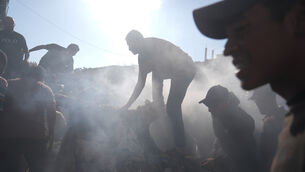
The missiles turned the car into a burning ball of wreckage and hundreds of residents rushed to the scene.
“When we started trying to evacuate them (the passengers) from the car, another missile attack took place while a huge number of people were gathering trying to help the wounded,” said shopkeeper Massoud Ramadan, who was hurt by shrapnel.
Dr Moawiya Hassanain, director of the city’s Shifa Hospital, said seven people were killed and 30 injured. Among the wounded were eight children under the age of 14.
Israeli military officials said there was no connection between the bus bombing and the two Hamas fugitives targeted in the missile strike. They said Massoud had commanded several armed Hamas cells.
Palestinian Cabinet Minister Yasser Abed Rabbo condemned the bus bombing. “We believe the crime of yesterday in Gaza (the failed attack on Rantisi) does not justify in any way a similar crime in Jerusalem today,” he said.
He said the US government needed to step in and end the violence.
David Baker, an official in Sharon’s office, said “the brutal Jerusalem attack is proof the Palestinian Authority must take immediate steps to prevent these types of terrorist attacks from being unleashed on Israel.”
CONNECT WITH US TODAY



Be the first to know the latest news and updates