British troops 'poke a toe into Basra'
British forces today made their deepest incursion yet into Basra in an operation described as “poking a toe” into the city.
They met a forthright response – but dealt with it successfully, raising hopes that they can go on to take Iraq’s strategically crucial second city.
As British troops tested the enemy’s reaction to their presence, rocket-propelled grenades and machine-gun rounds hit British positions and an Iraqi T-55 tank was seen advancing towards the frontline, Greg Swift of the Daily Express reported.
But within minutes the Desert Rats had returned fire, destroying the enemy tank, reducing the rocket-propelled grenade bunker to rubble and capturing 12 Iraqi prisoners of war.
Zulu Company of the 1st Battalion The Royal Regiment of Fusiliers (1RRF), backed by Challenger 2 tanks of the Queens Dragoon Guards, came under fire after establishing an advanced vehicle checkpoint (VCP) in Basra.
Set up on the main junction through which the city’s traffic flows, the VCP was the furthest forward any unit of the British Army has been.
Lieutenant Colonel David Paterson, commanding officer of 1RRF, said the aim of the checkpoint was to “poke a toe into Basra to see what happens.”
He explained: “The purpose is to get information from the civilians going in and out of the city about what is happening right inside.
“We need to establish that interface because we need to know the conditions there before we go into Basra.
“We don’t want to isolate the city – which is why the bridges have been opened to allow civilians to move backwards and forwards.
“But we do need to stabilise it militarily and that is why we are trying this aggressive forward VCP.
“So far it has been pretty quiet – we’ve destroyed an enemy tank and an anti-aircraft gun. And since we got control of the situation the enemy has not thrown anything at us that we can’t handle.”
The checkpoint stretched across 700 yards of road and vehicles passing through were thoroughly searched.
By early morning, a column of smartly dressed but weary-looking prisoners were marched back towards the British positions.
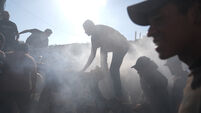
Also today, a few hundred yards behind the front line, troops brought two fire engines from the Basra International Airport to tackle a massive oil blaze.
Retreating Iraqis had dug a ditch in front of an oil supply line which they fractured before setting alight the subsequent spillage.
With thick black clouds billowing from the blaze, the crews struggled with the intense heat as they poured fire-extinguishing foam over it.
Despite their initial efforts it quickly became apparent that a more concerted and expert technique would be required to douse the flames.
Richard Gaisford, a British ITN journalist embedded with coalition troops, told CNN that toxic fumes were spreading across Basra.
Meanwhile a British Army spokesman said military chiefs had underestimated the legacy of their failure to back the 1991 Basra uprising.
Commanders hoped the one million-plus people living in the southern city would rebel once more against Saddam Hussein’s regime.
Instead, paramilitaries loyal to the Iraqi leader have forced the stand-off with British troops halted on the outskirts of the city.
People are still too afraid to stage the revolt that would open their city to the troops and humanitarian aid, said Colonel Chris Vernon.
“The level of fear we did not estimate – it runs so deep,” Col Vernon admitted.
Then the people of Basra, encouraged by the first Gulf War, rebelled against Saddam only to be abandoned by the Western allies to their fate.
Col Vernon stopped short of criticising that decision, saying it was made “way beyond my level and 10 years before I stand here”.
But he added: “The legacy created by that is making it very, very difficult for us to achieve what we want to achieve.”
Basra, which is dominated by Shiite Muslims persecuted by Saddam’s regime, was expected to welcome coalition troops.
Military planners hoped a show of force outside the city would encourage ordinary Iraqis to topple the regime without bloody street-to-street fighting.
They also hoped the pattern might be repeated in the capital Baghdad.
Despite frequent raids on Baath Party sites inside Basra, the regime still retains a fierce grip over the people, Col Vernon admitted.