Summit is 'last bit of diplomacy' effort
White House aides said US President George Bush approved the summit on the Azores and a brief extension of diplomacy out of respect for British Prime Minister Tony Blair, whose support for the US president has drawn severe criticism in Britain.
Spokesman Ari Fleischer described the talks as ”an effort to pursue every last bit of diplomacy” in the face of fading hopes for approval of a US war resolution.
President Bush will fly to the Azores on Sunday for a one-day trip,
“The president is still committed to this diplomatic process and is still committed to try to push (the resolution) through the United Nations. We shall see if that can or cannot be done,” Fleischer said.
Bush, with Tony Blair and his Spanish counterpart Jose Maria Aznar, also are likely to discuss plans for Iraq in any scenario in which President Saddam Hussein deposed.
At the United Nations, several Security Council members said they hoped the summit would provide a peaceful compromise.
“If it could in any way contribute to getting a consensus on the council, we would welcome it,” said Pakistan’s ambassador, Munir Akram.
On the verge of an embarrassing defeat at the US, the White House arranged the summit as it back-pedalled from a pledge to hold a vote on the resolution this week.
US officials also said for the first time that Bush may withdraw the measure - and fight Iraq without the UN’s consent.
The president has said that without the United Nations, he could form a “coalition of the willing” outside the UN.
That coalition would include Britain and Spain, US officials said, but they insisted that Bush, Blair and Aznar will not discuss battlefield tactics and detailed military strategies.
The summit is intended to be a symbolic show of resolve to do everything possible to wage war, said US officials, even as they conceded that war appears almost inevitable.
As he prepared to leave for the Azores, Bush sought to remind Americans that he believes removing Saddam will pave way to peace in the Middle East.
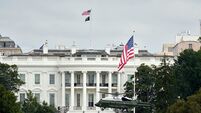
Standing at the White House with Secretary of State Colin Powell, the president pledged Friday to release his long-sought “road map” for Middle East peace once a credible Palestinian prime minister takes office.
Fleischer said Bush still hoped that war could be avoided, perhaps by Saddam seeking exile.
But he also said that stiff opposition to a UN resolution has eased pressure against the Iraqi president.
“Here is where the stakes are. If the Security Council is able to pass a resolution – much like what has been discussed by the United States, the British and the Spanish – it is still possible for Saddam Hussein to see the writing on the wall and to get out of Iraq and therefore preserve peace,” he said.
“To the degree that other nations erase the writing on the wall, it makes it less likely for Saddam Hussein to leave and that this can be settled peacefully,” Fleischer said.
France’s promise to veto any war resolution has angered Bush and could complicate US-French relations long after the Iraq conflict, several administration officials said.
The Azores Islands, which belong to Portugal, are a traditional eastern-Atlantic refuelling stop.
Portugal is among the countries which have offered Bush logistical support in any war in Iraq, and it granted US permission to use Lajes Field air base in the island chain.
The summit will be held on the air base, which is 2,300 miles from the US and 900 miles from the European mainland.
News of the meeting first surfaced on Thursday, but officials said planning had stopped, only to confirm hours later that talks had resumed amid tense discussions at the United Nations.
A senior administration official said the US was waiting for Mexico and Chile to decide.
In a constantly shifting lineup, the two Latin American countries could ensure the nine votes required for council approval – provided there was no veto, which both France and Russia have said they would cast.
Whatever the decision, the United States will declare that Iraq has missed its final opportunity to disarm, the official said.
The Security Council vote wasn’t Bush’s only problem.
The president sent a letter to incoming Turkish Premier Recep Tayyip Erdogan and Vice President Dick Cheney called the leader in hopes of securing permission to invade Iraq through Turkey or to use Turkish airspace for an attack.
But Turkey dismissed the appeals, US officials said, and the Pentagon began preparing invasion plans that did not include Turkey.
A US fleet began moving to the Mediterranean to the Red Sea today.