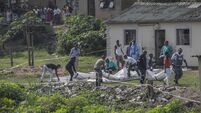
Indian experts study wreckage from bombed train
Bomb experts in India were today searching the mangled wreckage of a train for traces of a bomb that killed 11 people and injured 64 others.
Security was stepped up across Bombay, the country’s commercial hub. Police checked all suspicious objects and carried out random checks on commuters at bus and railway stations across the city.
Last night’s explosion ripped open the top and front of a train carriage reserved for women. It came a day after the 10th anniversary of a dozen bomb attacks in Bombay that killed 257 people and wounded at least 1,000.
Police suspected Muslim militants carried out the attacks 10 years ago in revenge for the destruction of a 16th century mosque by fundamentalist Hindus in 1992.
The Maharashtra state government said it had information that there might be trouble around the anniversary.
“We had increased security and ideally would have liked to prevent people from carrying large parcels in public transport. But there is a limit to what can be disallowed,” said a police spokesman.
“The magnitude of the blast is such that I cannot rule out the possibility of a terrorist strike.”
Police said the explosive was jammed between the women’s carriage and another, but most of the force went into the women’s compartment. Some Indian trains and buses have special compartments or areas for women to protect them from sexual harassment.
Three crude bombs have exploded near Bombay railway stations over the past four months. Yesterday’s was the most severe.
Police say Islamic hard-line groups were responsible for at least two attacks and have arrested six men for plotting the explosions. Two of the men accused were deported to India from the United Arab Emirates, where police say they had fled after the blasts.
At the three Bombay hospitals where the injured were taken, hundreds of relatives gathered. Some wailed in mourning, others sat on the floor and stared vacantly.
“My sister was supposed to get married on Sunday. Now she is no more. I can’t understand why this happened,” wept Laxmikant Patnaik, his maroon shirt speckled with blood.
Patnaik, travelling in a carriage near the one reserved for women in which his 25-year-old sister Rena was seated, had helped a couple of women jump from the smouldering train.
“I searched for my sister and then only found her body in hospital,” he said.
Swathed in bandages, survivors like electrician Rajesh Shirke said the train shuddered when the blast occurred.
“Our compartment vibrated and everyone began jumping off the train when we heard the blast,” said Shirke. “I saw body parts and so much blood on the tracks. This I will not be able to forget.”
Doctors said panic caused many commuters to jump onto the tracks and most of the injuries were fractured limbs.

CONNECT WITH US TODAY



Be the first to know the latest news and updates