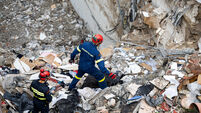
Suicide bombing kills policeman
A suicide bomber blew himself up at a bus stop in northern Israel today, killing himself and an Israeli policeman.
The attack during evening rush hour also wounded another officer and a bystander. It was the first suicide strike in six weeks.
The blast near the Israeli Arab town of Umm el-Fahm came hours after Israel rejected a Palestinian offer to stop attacks on citizens as part of a gradual truce deal.
Israeli Premier Ariel Sharon had said only a complete cessation of violence would do.
The man detonated his explosives as he approached a police van that had pulled up at the bus stop to check him, officials said.
Police believe he originally intended to blow himself up on a bus.
One witness said “the body of the terrorist was simply cut in two.”
Mahmoud Zahar, a spokesman for the Islamic militant group Hamas, welcomed the attack, saying “the Palestinians have every right to fight against the occupation”.
Two other Israeli citizens were killed today. A motorist died in the West Bank after gunmen from the Al Aqsa Martyrs’ Brigades, a militia linked to Palestinian leader Yasser Arafat, opened fire on his car.
Elsewhere in the West Bank, the burned body of a Jewish settler was found in a rubbish dump. His family had reported him missing yesterday.
Also today, Israeli troops shot dead an armed Palestinian as he approached them in the West Bank village of Tamoun.
The head of Israel’s Shin Bet security service, Avi Dichter, told Israel’s Cabinet today that the Palestinian Authority had done nothing to prevent attacks.
Hopes had been raised by a meeting between Israeli Foreign Minister Shimon Peres and Palestinian Planning Minister Nabil Shaath on the sidelines of the UN General Assembly in New York yesterday.
The so-called Quartet of Mideast mediators - senior officials from the US, the UN, the EU and Russia - had earlier expressed support for a general road-map to Palestinian statehood within three years, but did not agree on a detailed plan, as the Palestinians had hoped.
The plan envisages Palestinian reform and elections, followed by a provisional Palestinian state in some of the West Bank and Gaza in 2003, and a final peace agreement by 2005.
Sharon adviser Raanan Gissin said Israel supports the Quartet’s outline.
“We accept the map as long as it all comes after a cessation of violence,” he said. “This obligates the Palestinians, and that is why Shaath is opposed.”