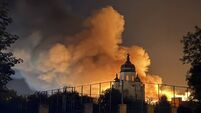
Four die in Moscow explosion
At least four people were killed and up to nine more were feared trapped in the debris of a Moscow residential building that collapsed following an explosion.
A spokesman for the Emergency Situations Ministry, Dmitry Paskevich, said today that yesterday’s blast killed one person and injured at least four.
Three more bodies, one of a woman and one of a young girl, were pulled out of the wreckage later in the morning.
Moscow police spokesman Valery Gribakin said the most likely cause of the explosion was a natural gas leak on the second floor.
Emergency situations minister Sergei Shoigu echoed that theory, saying in televised remarks that he believed gas was the likely cause.
Authorities said they had found no trace of explosives in the remains of the building, Russian media reported.
Mr Shoigu said that four people were pulled alive from the ruins, according to the Interfax news agency.
But ITAR-Tass said that eight people were pulled out, including a woman with burns over 80% of her body and three others who were seriously injured.
Before the three bodies were pulled out this morning, Mr Paskevich said there were 12 people missing, including a baby, eight women and three men.
An emergency worker said rescuers were focusing their efforts on two pockets in the wreckage where they believed survivors could be.
ITAR-Tass said about 40 apartments had been destroyed.
"It was such an explosion," said 78-year-old resident Zinaida Burlakova. "I thought at first it was thunder, the walls were shaking. I was afraid to go outside. Then someone came to my door and started yelling, ‘Go outside!’."
Nadezhda Medvedeva was standing outside the ruins waiting for news of her friend, who lived with her family in a fourth-floor apartment that was wrecked in the blast.
"They just got back from vacation today," she said, adding that she had spoken to her friend less than three hours before the explosion and that she had been at home.
Emergency workers used a large crane to pick through the wreckage under floodlights.
Rescuers used heavy machinery to move large chunks of rubble, then clambered on the piles and shone flashlights down into the wreckage.
Toward dawn, emergency workers cut the engines of bulldozers and other equipment at the site several times while sniffer dogs were led slowly across the rubble.
Most Russian apartments use natural gas for cooking. Leaks from aging pipes and stoves are common, killing and injuring scores of people every year.
But the explosion raised fears of a terrorist attack, as well. Among the officials who rushed to the scene of the explosion was Nikolai Patrushev, the head of the Federal Security Service.
Residents of the building said on NTV that after the explosion they smelled gunpowder, but not gas.
They also noted that the blast had not sparked a fire, as is usually the case in gas explosions.
Three years ago, a series of apartment house explosions that authorities blamed on Chechen rebels rocked Moscow and other cities, killing about 300 people.
Rebels continue to unleash attacks that kill Russian servicemen and Moscow-allied Chechen officials virtually every day.
Rebel attacks have picked up in recent weeks, and investigators say the rebels are probably responsible for the crash of a troop transport helicopter on Monday, which left 114 dead and 33 injured.
Interfax reported that investigators found a Strela anti-aircraft missile launcher that had been used to shoot down the Mi-26 helicopter.

CONNECT WITH US TODAY



Be the first to know the latest news and updates