Five die after Israel enters Arafat's compound
Israel declared Palestinian leader Yasser Arafat an enemy today and sent tanks and troops charging into his compound in the West Bank town of Ramallah, sparking a battle with security forces.
The incursion was part of a major military operation in response to Palestinian terror attacks which have killed 27 Israeli civilians in three days.
Israel said it would not harm Arafat, but tank shells punched holes in his walled compound.
Israeli troops seized at least two buildings inside the sprawling compound and tank fire hit the building where Arafat was.
The troops exchanged fire with Arafat’s security guards, wounding 13, and demanded over loudspeakers that all armed men in the compound surrender. A building next to Arafat’s office caught fire.
The Friday morning raid was the closest Israeli forces have come to the Palestinian leader in 18 months of fighting.
Israel has confined Arafat to the headquarters for four months, barring him from travelling.
Arafat told the Arab satellite television channel Al Jazeera in a telephone interview: ‘‘They want me under arrest or in exile or dead, but I am telling them, I prefer to be martyred.
‘‘May God make us martyrs.’’
‘‘The Israeli forces are surrounding my office with tanks,’’ he said. ‘‘They are shelling the headquarters and we have some people who are injured, and can’t move them to the hospitals.’’
Several hours after the operation began, Israeli troops could be seen moving around inside the compound, which stretches for a city block on all four sides.
Palestinian security forces initially waged firefights with the Israeli troops, but later took cover inside buildings, and there was only sporadic shooting.
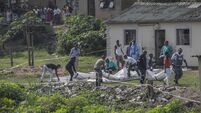
No deaths were reported inside the compound, but Palestinian doctors said four Palestinians two civilians and two members of the Palestinian security forces were killed in the streets of Ramallah.
The Israeli military said one army officer was killed.
Israeli Prime Minister Ariel Sharon told a Jerusalem news conference following an all-night Cabinet
meeting that Israel now considered Arafat an ‘‘enemy’’ and that he would be completely isolated ‘‘at this stage’’.
Sharon did not explain what the declaration would mean in practical terms, but left open the possibility that the Palestinian leader could be expelled from the Palestinian territories at a later time, as several Israeli Cabinet ministers have demanded.
Sharon’s statement, combined with the Israeli military action, appeared to extinguish any immediate prospects that United States envoy Anthony Zinni could work out a truce.
The US Embassy said Zinni, who has been attempting to broker a ceasefire for the past two weeks, planned to keep working and scheduled separate talks today with the Israelis and the Palestinians.
Sharon, in a reference to Zinni’s truce effort, said Israel was prepared to do everything it could for a cease-fire, ‘‘but all Israel got in return was terrorism, terrorism and more terrorism’’.
The Israeli invasion came a day after an Arab summit in Beirut, Lebanon, approved a plan which calls on Arab nations to develop normal relations with Israel in exchange for its withdrawal from territory captured in the 1967 Mideast war.
Arafat told Abu Dhabi television: ‘‘This brutal aggression is a response to the Arab summit in Beirut.
This is the Israeli response to any peace attempt. Because they don’t want peace, they don’t want peace.’’
The plan marked the first time in more than a half-century of Mideast conflict that Arab states have made such an offer. Israel said it would study the plan, but its top priority was responding to Palestinian attacks.
At the Israeli Cabinet meeting, ministers approved an extended, large-scale military operation that would be carried out in stages. In a first stage, Israeli forces entered Ramallah, even as the ministers were meeting.
Israeli Defence Minister Binyamin Ben-Eliezer said that no Palestinian engaged in terror activity against Israel was immune from Israeli reprisals.
Asked whether that also applied to Arafat, he said the Palestinian leader would not be harmed physically.
Earlier this month, the Israeli military carried out an extensive operation in the West Bank and Gaza Strip, sending 20,000 soldiers into towns, villages and refugee camps in a hunt for Palestinian militants. That operation was the biggest since Israel’s 1982 invasion of Lebanon.
The Cabinet decided early today to call up reserves, indicating that the military strike getting under way would be even bigger than the previous raids.
Sharon blamed Arafat personally for three bloody attacks in three days a suicide bombing that killed 21 guests at a Passover dinner on Wednesday night, and attacks on two Jewish settlements, one yesterday and one early today, in which six Israelis died.
CONNECT WITH US TODAY



Be the first to know the latest news and updates