Brussels attacks: Europe’s ‘most wanted man’ dies in bombing
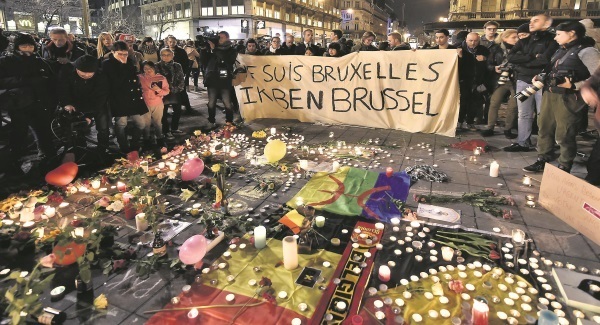
The revelation that Najim Laachraoui was among the bombers who died came as Belgians began three days of mourning for the victims of the Brussels airport and metro bombings.
The country remained on high alert as authorities hunted for one of the suspected attackers seen on surveillance video with Laachraoui — who was thought to have escaped after the Brussel attacks — and one other suicide bomber.
Authorities had dubbed him Europe’s most wanted man.
The disclosure came as Turkish authorities revealed they had caught one of the suicide bombers near the Turkish-Syrian border in July and sent him back to the Netherlands. They warned both that country and Belgium that he was a “foreign terrorist fighter.” But a Turkish official said the bomber was allowed to go free because Belgian authorities could not establish any ties to extremism.
Belgian authorities had initially thought Laachraoui was one of the Brussels airport bombers captured on CCTV in a black cap and white coat who was thought to have fled after the attacks. But subsequently DNA showed he was one of the other two suicide bombers.

Police had been hunting Laachraoui since last week, suspecting him of being an accomplice of top Paris attacks suspect Salah Abdeslam, who was arrested on Friday.
Two officials told AP that Laachraoui’s DNA was verified as that of one of the suicide bombers on Tuesday, after samples were taken from remains found at the blast site at Brussels airport.
Laachraoui is believed to have made the suicide vests used in the Paris attacks, a French police official told AP, adding that Laachraoui’s DNA was found on all of the vests as well as in a Brussels apartment where they were made. Several people who may be linked to the attacks were still on the loose and the country’s threat alert remained at its highest level, meaning there was danger of an imminent attack, said Paul Van Tigchelt, head of Belgium’s terrorism threat body.
The attacks killed 31 people, not including three suicide bombers, and injured 270 others, authorities said.
As government offices, schools and residents held a moment of silence to honour the dead, the mood was defiance mixed with anxiety that others involved in the attacks are still at large.
Belgian Federal Prosecutor Frederic Van Leeuw identified two of the Brussels attackers as brothers — Ibrahim El Bakraoui, a suicide bomber at the airport, and Khalid El Bakraoui, who targeted the subway.
Investigators raided the Brussels neighbourhood of Schaerbeek after the attacks and found a computer in a rubbish bin on the street including a note from Ibrahim El Bakraoui saying he felt increasingly unsafe and feared landing in prison. He was the brother who Turkish officials said was deported from Turkey to the Netherlands. Belgium’s justice minister said authorities there knew him as a common criminal, not an extremist, and that he was sent back to the Netherlands, not Belgium.
A taxi driver who took Ibrahim El Bakraoui and two others to the airport led investigators to an apartment where they found 15 kilograms (33lbs) of TATP explosives, along with nails and other materials used to make bombs, Van Leeuw said.
Two were suicide bombers, the prosecutor said; the other man in a white jacket and black cap fled before the bombs went off, leaving behind a bag full of explosives. That bag later blew up, but no one was injured.