Mushroom fossil is oldest land-based organism
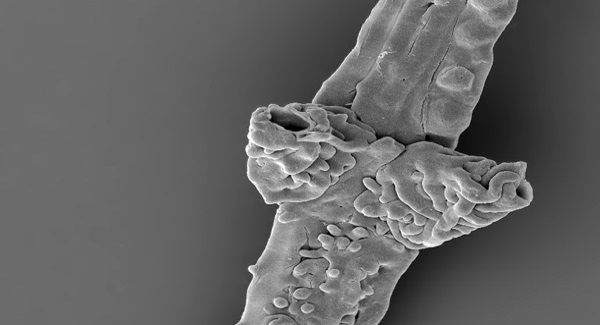
The fungus and others like it paved the way for more complex plants and later animals making the leap from the oceans to the land by kick-starting the process of soil formation.
The early pioneer, known as tortotubus, has a structure similar to that found in modern fungi and was probably able to store and transport nutrients through the process of decomposition.
Martin Smith, who carried out a study of the fungus while working at Cambridge University, said: “During the period when this organism existed, life was almost entirely restricted to the oceans: nothing more complex than simple mossy and lichen-like plants had yet evolved on the land.
“But before there could be flowering plants or trees, or the animals that depend on them, the processes of rot and soil formation needed to be established.”
Dr Smith, now at the University of Durham, analysed a number of micro- fossils from Sweden and Scotland, each shorter than the width of a human hair.
He was able to show that what were once thought to represent parts of two different organisms actually belonged to one, at different stages of growth.
Fungi play a vital role in the nitrogen cycle, the process by which nitrates in the soil are taken up by plant roots and passed along the food chain into animals.
Tortotubus had a cord-like structure, similar to that of some modern fungi, allowing it to spread out and colonise surfaces.
In modern fungi such a structure is associated with decomposition.
“What we see in this fossil is complex fungal ‘behaviour’ in some of the earliest terrestrial ecosystems, contributing to soil formation and kick-starting the process of rotting on land,” said Dr Smith.
What is less clear is what existed 440 million years ago for tortotubus to decompose. It is likely there were bacteria or algae on land during this period, according to the scientists whose findings are reported in the Botanical Journal of the Linnean Society.