Doctors worked ‘in harmony’ after Paris attacks left 368 people injured
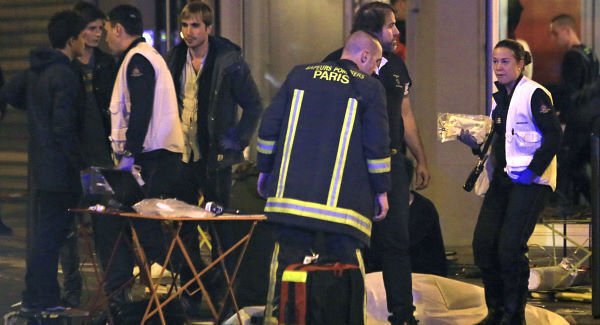
The demand for tourniquets to control blood flow in gunshot victims in the wake of the Paris attacks was so high that emergency services teams returned to hospitals without their belts.
Doctors worked ‘in harmony’ after Paris attacks left 368 people injured

And in what medics working in Paris hospitals on that fateful night describe as “a cruel irony”, some doctors initially believed that activation of the city’s emergency plan was a simulation exercise, because emergency personnel had actually taken part in an simulation earlier that day in the event of multiple shootings in the French capital.

The account of how doctors coped with a huge influx of wounded on the night of November 13 when a series of terrorist attacks paralysed Paris, leaving 130 dead and 368 injured, is recounted in chilling detail in an article in The Lancet.

The speed and professionalism with which Paris’s public hospital system, the Assistance Publique- Hopitaux de Paris (APHP), operated on the night is outlined.

Within minutes of being alerted to explosions outside the Stade de France, the APHP crisis unit, capable of co-ordinating 40 hospitals, opened.

A 20-year-old white plan (emergency plan), never before used, was activated.

“It is a big decision, and timing is key: It would lose its effectiveness if taken too late,” the doctors wrote.

In the event, timing was perfect. At no time during the emergency was there a shortage of personnel.

As the number of victims increased following the massacre at the Bataclan theatre, 10 helicopters were put on standby in the event of needing to ship patients to hospitals further afield.

A psychological support centre was set up, with 35 psychiatrists, psychologists, nurses and volunteers in a central Paris hospital.

Most of them had played a similar role after the Charlie Hebdo attacks.

An emergency physician describes how more than 35 surgical teams operated on the most serious injuries, most of them bullet-related.

He said the attacks “were not a surprise”, that since January, 2015, “all state departments had known that a multi-site shooting could happen” and for two years, emergency personnel had been “developing treatment protocols for victims of gunfire wounds”.

However, the physician said no simulation “had ever anticipated such a boost in the scale of violence”.

Despite this, doctors and nurses surpassed themselves “never before had such a number of victims been reached and so many wounded been operated on urgently.

"A new threshold has been crossed,” he said.

An anaethesiologist describes how nurses and doctors arrived spontaneously at the hospital and succeeded in opening 10 operating rooms where normally there were two.

Within 24 hours, all emergency surgeries had been done and the hospital “was nearly ready to cope with another attack that we all feared could occur”, he said.

A trauma surgeon wrote that if he had to summarise the “winning formula”, “I would say that spontaneity and professionalism were the key ingredients”.

Doctors operated continuously on Friday night and all day on Saturday.

The surgeon said all but one of the patients who arrived at his hospital were under 40 years of age and all had been shot.

Despite the challenges, the human factor was crucial “difficulties vanished, working together appeared fluid and somehow harmonious”.

More in this section

Cookie Policy Privacy Policy Brand Safety FAQ Help Contact Us Terms and Conditions

© Examiner Echo Group Limited