50 dead, hundreds injured, in explosions
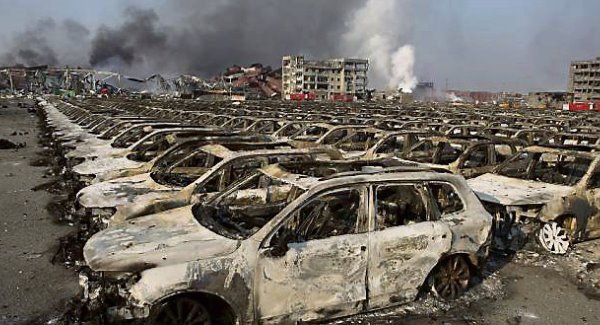
At least 50 people are dead and hundreds others injured or unaccounted for after Wednesday night’s two huge explosions tore through an industrial area where toxic chemicals and gas were stored in the northeast Chinese port city of Tianjin.
At least 700 people were injured, more than 71 seriously, the Tianjin government said on its Weibo microblog, and the official Xinhua news agency said two fires were still burning. At least 12 firefighters were among the dead.
The blasts, so large that they were seen by satellites in space, sent shockwaves through apartment blocks kilometers away in the port city of 15 million people. Internet videos showed fireballs shooting into the sky and the U.S. Geological Survey registered the blasts as seismic events.
Vast areas of the port – the 10th largest in the world – were devastated, crumpled shipping containers were thrown around like match sticks, hundreds of new cars were torched and port buildings left as burnt-out shells, Reuters witnesses said.
The municipal government in Tianjin, a key port and petrochemical processing hub about 75 miles east of Beijing, said 701 people were injured, including 71 in serious condition. It gave no figure for the missing.
There was no indication of what caused the blasts, and no sign of any toxic cloud in the air as firefighters brought the fire largely under control by morning.
But the Tianjin government suspended further firefighting to allow a team of chemical experts to survey hazardous materials at the site, assess dangers to the environment and decide how best to proceed.
State media said senior management of the company had been detained, and that President Xi Jinping demanded severe punishment for anyone found responsible for the explosions.
In a sign of sensitivity over the hazardous materials stored at the warehouse, state broadcaster CCTV went into a live broadcast of a news conference in Tianjin when the head of the municipality’s Environmental Protection Bureau chief, Wen Wurui, was speaking.
He said there had been no apparent impact on air monitoring stations, but that water samples were still being examined.
But when a reporter asked him whether the chemicals at the warehouse had been stored far enough away from residences in the area and Mr Wen seemed at a loss for a response, the broadcaster suddenly cut away from the news conference, only to return to it again later.
Authorities said the blasts started at shipping containers at the warehouse owned by Ruihai Logistics, a company that says it stores hazardous materials including flammable petrochemicals, sodium cyanide and toluene diisocyanate.
As is customary during disasters, Chinese authorities tried to keep a tight control over information. Police kept journalists and bystanders away with a cordon about 1 or 2 kilometers (about a mile) from the site. On China’s popular microblogging platform of Weibo, some users complained that their posts about the blasts were deleted, and the number of searchable posts on the disaster fluctuated, in a sign that authorities were manipulating or placing limits on the number of posts.
Reuters