Pent-up energy of Himalayas was unleashed
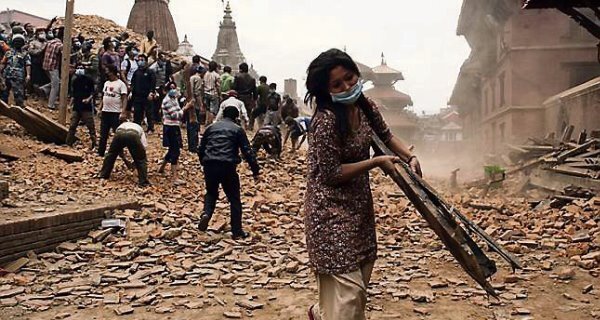
The world’s highest mountain range marks a 2,400km-long region of geologic upheaval where two tectonic plates — massive sections of the Earth’s crust that fit together like pieces of a jigsaw puzzle — are pressing together, generating unimaginable forces.
David Rothery, professor of Planetary Geosciences at the Open University, explained how without the buckling rock, Mount Everest and its companion mountains would not exist.
He said: “What’s happening is that the northern region of India, which broke away from Africa tens of millions of years ago, is colliding with central Asia. India is trying to move northwards by four or five centimetres per year. This has thrown up the Himalayas — the front leading edge of India is being thrust back over itself.
“If India finally ground to a halt relative to Asia, the Himalayas would erode down. But as well as being eroded away at a rate of several millimetres a year, they’re still being pushed up.
“It more or less balances out. If that wasn’t happening, the mountains would have disappeared in about 10 million years, but they’re still there.
“The strain along the fault line builds up and suddenly lets rip. We’re talking about roughly 80 years-worth of strain since the last major earthquake occurred in the 1930s. All these after shocks that are occurring are nearby bits of the fault letting rip as well.”
At a prescient recent meeting of seismologists in Kathmandu, experts discussed the prospects of a big earthquake happening because there had not been one for decades, said Rothery.
However, he stressed that predicting major earthquakes was incredibly difficult, even with sophisticated computer modelling.
“You can get small tremors on a regular basis but these big earthquakes happen out of the blue,” he said. “Sometimes some of the strain can be released by lots of little earthquakes, but you can’t rely on that happening.
“When some time has passed without a major earthquake, people get complacent. Those responsible for building construction can’t afford to protect them against earthquakes and don’t bother.
“I think we’ll get better at identifying places where earthquakes might happen, but as for giving people a week’s warning to get out of an area, that’s unlikely.”
DISCOVER MORE CONTENT LIKE THIS
CONNECT WITH US TODAY



Be the first to know the latest news and updates