Rosetta team opts to land probe on ‘head’ of comet
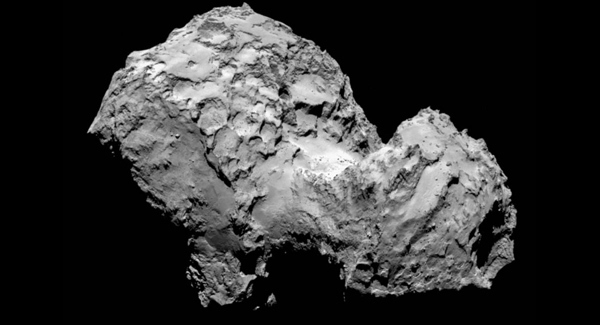
The probe or lander will be dispatched from the Rosetta spacecraft, which was launched by the European Space Agency (ESA) in 2004 and has been tracking comet 67P/Churyumov-Gerasimenko on its trip around the sun.
Scientists hope data gathered by the landers on the surface of the comet will allow them to peek into a kind of astronomical time capsule, offering clues about what the world looked like when our solar system was born. The lander will drill more than 20cm into the comet’s surface to collect samples for analysis.
Timing is vital; they need to wait until the comet is close enough to the sun for the probe’s solar panels to work, but must also land it before increasing heat causes activity levels of the comet to rise so much it would endanger a safe landing.
They have determined that a landing window will open up on Nov 11, when the comet will be 450 million km from the sun.
Rosetta caught up with the comet in August and since then has been relaying pictures to earth. While it is within 30km of the comet, the pictures’ resolution is not high enough to allow detailed inspection of its surface.
“We don’t know what the terrain looks like in detail,” Paolo Ferri, head of mission operations at ESA, told Reuters. “But there’s certainly no nice landing strip. We have to rush into this with the minimum amount of information.”
Known as Philae, the three-legged lander must not descend too slowly or too quickly, its trajectory has to take into account the rotation of the comet, there has to be enough battery power left after landing to deploy its instruments, and detaching it from Rosetta has to be perfectly timed. Once the box-shaped 100kg probe has landed, the team will concentrate on setting up Philae’s solar panels so it can start relaying data to Rosetta, which will continue to orbit the comet until at least of the end of 2015 and possibly longer if more funding can found.
An initial 10 landing sites were whittled down to five and a team of engineers and scientists met over the weekend to select one preferred site and one back-up. Site J is on the “head” of the comet, an irregular body just over 4km across at its widest point, the ESA said in a statement.
It said the chosen site offers “unique scientific potential, with hints of activity nearby, and minimum risk to the lander compared to the other candidate sites”.
A backup, Site C, is on the “body” of the comet.
CONNECT WITH US TODAY



Be the first to know the latest news and updates