Floor ‘splashed with blood’ as health staff among ebola victims
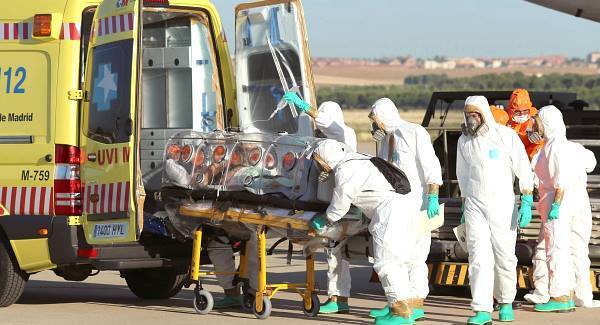
Liberia, Sierra Leone, and Guinea, the countries at the centre of the outbreak, are poor and decentralised, with scant healthcare resources to help contain the disease, which kills the majority of people infected. At last count, there were 1,603 suspected and confirmed cases and 887 deaths.
In The New Yorker, Richard Preston, author of The Hot Zone, describes the harrowing situation in Sierra Leone, which has the highest number of suspected cases, at 646.
Daniel Bausch, a doctor in Louisiana and an ebola expert, tells Preston about the scene inside an ebola ward he helped set up, “a cluster of small cinder- block buildings” where the facility’s director Dr Sheik Humarr Khan and a single nurse were caring for 30 ebola patients when he arrived.
“The floor was splashed with blood, vomitus, faeces, and urine,” Bausch told Preston, explaining that sickened patients have trouble staying in bed.
“You need a whole team to decontaminate the bed and lift the patient up off the floor and put him safely back in bed.”
Anyone who comes close to the patients must wear stuffy, cumbersome biohazard suits; the temperature inside them can reportedly rise to dangerous levels.
The nurses were overwhelmed and underpaid. They were “working 12-hour days... and were supposed to be earning an extra $30 a week in hazard pay,” Preston writes. “But the government of Sierra Leone had not provided it. Not unreasonably, many nurses had stopped showing up.”
Joseph Fair, another US ebola expert, travelled to Kenema to help, Preston reports. He was very close to Khan, the facility’s director; Mbalu Sankoh, its chief nurse; and Alex Moigboi, a senior nurse.
Ten days after Fair’s arrival, Sankoh was dead. A fever she suspected was malaria may have actually been ebola. Moigboi, too, died soon after, and later Khan, who died in a bed inside the facility he had run for a decade.
“For weeks,” Preston writes, “Dr Fair has been going to funerals in Kenema,” as a growing number of the region’s healthcare workers have died. Now, Fair says, there is “a huge void”.
Elsewhere in the region, hundreds of healthcare professionals from all over the world are working around the clock, as Nicky Woolf details in The Guardian.
Doctors and nurses routinely work 15–16 hour days, seven days a week. William Fischer, a US doctor, sent “a brief email to friends and family that said ‘I love you all’,” before heading into the centre of the outbreak, on “marching orders from the World Health Organisation”.
Monia Sayah, a nurse with Doctors Without Borders, said patients know how bad their odds are. “You can see the fear, the desperation when they look at us,” Sayah says. “They hold your hand and don’t want to let go.”

CONNECT WITH US TODAY



Be the first to know the latest news and updates