Early Picasso masterpiece reveals hidden mystery man
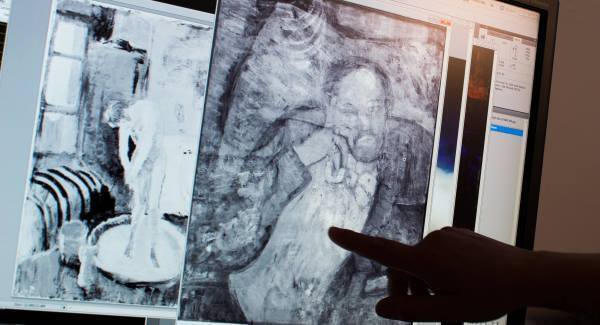

Now the question that conservators at The Phillips Collection in Washington hope to answer is simply: Who is he?
It is a mystery that is fuelling new research about the 1901 painting created early in Picasso’s career while he was working in Paris at the start of his distinctive blue period of melancholy subjects.
Over the past five years, experts from The Phillips Collection, the National Gallery of Art, Cornell University, and Delaware’s Winterthur Museum have developed a clearer image of the mystery picture under the surface. It is a portrait of an unknown man painted in a vertical composition by one of the 20th century’s great artists.
“It’s really one of those moments that really makes what you do special,” said Patricia Favero — the conservator at The Phillips Collection who pieced together the best infrared image yet of the man’s face. “The second reaction was ‘well, who is it?’ We’re still working on answering that question.”
In 2008, improved infrared imagery revealed for the first time a man’s bearded face resting on his hand with three rings on his fingers. He is dressed in a jacket and bow tie.
A technical analysis confirmed the hidden portrait is a work Picasso probably painted just before The Blue Room, curators said.
Since the portrait was found, conservators have been using other technology to scan the painting for further insights.
Conservators long suspected there might be something under the surface of The Blue Room, which has been part of The Phillips Collection in Washington since 1927.
Brushstrokes on the piece clearly do not match the composition which depicts a woman bathing in Picasso’s studio.
A conservator noted the odd brushstrokes in a 1954 letter, but it was not until the 1990s that an X-ray of the painting first revealed a fuzzy image of something under the picture. It was not clear, however, that it was a portrait.
“When he had an idea, you know, he just had to get it down and realise it,” curator Susan Behrends Frank said, revealing that Picasso had hurriedly painted over another complete picture. “He could not afford to acquire new canvases every time he had an idea that he wanted to pursue.”
Scholars are researching who the man might be and why Picasso painted him. They have ruled out the possibility that it was a self-portrait.
One candidate is Paris art dealer Ambrose Villard, who hosted Picasso’s first show in 1901.
Curators are planning the first exhibit focused on The Blue Room as a seminal work in Picasso’s career for 2017. It will examine the revelation of the man’s portrait beneath the painting, as well as other Picasso works and his engagement with other artists.
For now, The Blue Room is part of a tour to South Korea until early 2015.
CONNECT WITH US TODAY



Be the first to know the latest news and updates