Obama: Russia’s on the wrong side of history

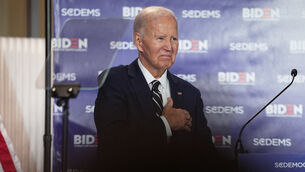
Obama said Russia has violated Ukraine’s sovereignty and international law, and he warned Russian President Vladimir Putin to change course.
“Over time this will be a costly proposition for Russia and now’s the time for them to consider whether they can serve their interests in a way that resorts to diplomacy as opposed to force,” Obama said from the Oval Office.
Earlier Russian forces controlling the strategic region of Crimea demanded the crew of two Ukrainian warships to surrender.
Ukrainian defence ministry spokesman Maksim Prauta said four Russian navy ships were blocking Ukraine’s anti-submarine warship Ternopil and the command ship Slavutych in Sevastopol’s harbour.
He said the Russians ordered the crew to surrender within the hour or face Russians storming and seizing the ships and crew.
Vladimir Anikin, a Russian defence ministry spokesman in Moscow, dismissed that report as nonsense, but he refused to elaborate.
Russia pressed for Ukrainian politicians to return to the February 21 agreement that promised to create a new unity government which would rule until an early election no later than December.
But the proposal seemed to be a non-starter as diplomats met in Brussels, Kiev and Geneva and warnings about the dangers of Russia’s military actions were issued from a host of European capitals.
On the ground, Russian troops controlled all Ukrainian border posts in Crimea, as well as all military facilities and a key ferry terminal, cementing their stranglehold on the strategic Ukrainian peninsula.
Russian foreign minister Sergey Lavrov, at UN meetings in Geneva, explained the reasoning behind Russia’s military invasion of Crimea. “This is a question of defending our citizens and compatriots, ensuring human rights, especially the right to life.”
Tension between Ukraine and Moscow rose sharply after Ukrainian president Viktor Yanukovych was pushed out by a protest movement made up of people who wanted closer ties with the European Union, more democracy and less corruption. Yanukovych fled to Russia last month after more than 80 demonstrators were killed — mostly by police — near Kiev’s central square, but insists he is still president.
In Kiev, Ukraine’s new prime minister admitted his country had “no military options on the table” to reverse Russia’s military move into its Crimea region, where Ukraine’s military admitted that pro-Russian troops have surrounded or taken over “practically all” its military facilities.
Prime Minister Arseniy Yatsenyuk appealed for outside help and insisted Crimea still remained part of his country.
“Any attempt of Russia to grab Crimea will have no success at all. Give us some time,” Yatsenyuk said at a news conference with British foreign secretary William Hague in Kiev.
But he added that “for today”, there were “no military options on the table.” He said his country was “urgently” asking for economic and political support from other countries.
In Crimea, home to two million mostly Russian-speaking people and landlord for Russia’s Black Sea Fleet at Sevastopol, Russian troops also controlled a ferry terminal in Kerch, just 20km across the water from Russia. That intensified fears in Kiev that Moscow will send more troops into the peninsula via that route.
CONNECT WITH US TODAY



Be the first to know the latest news and updates