Obama set to arm Syrian rebel forces
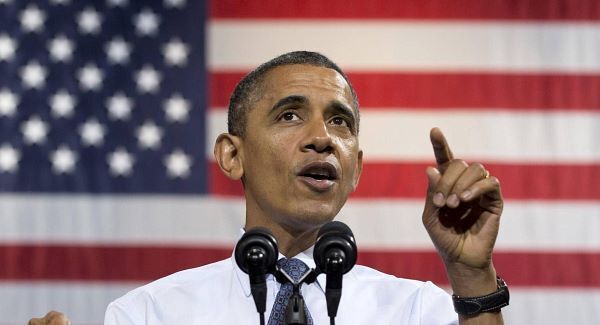
After months of deliberation, President Barack Obama’s administration said it would now arm rebels, having obtained proof the Syrian government used chemical weapons against fighters trying to overthrow president Bashar al-Assad.
Two senior Western diplomats said Washington is looking into a no-fly zone close to Syria’s southern border with Jordan.
“Washington is considering a no-fly zone to help Assad’s opponents,” one diplomat said. He said it would be limited “time-wise and area-wise, possibly near the Jordanian border”.
Imposing a no-fly zone would require the United States to destroy Syria’s sophisticated Russian-built air defences, thrusting it into the war with the sort of action NATO used to help topple Muammar Gaddafi in Libya two years ago.
Washington says it has not ruled it out, but a decision is not “imminent”.
“We have not made any decision to pursue a military operation such as a no-fly zone. And we have a range of contingency plans that we’ve drawn up,” US deputy National Security adviser Ben Rhodes said.
“A no-fly zone . . . would carry with it great and open-ended costs for the US and the international community. It’s far more complex to undertake the type of effort, for instance, in Syria than it was in Libya.”
Any such move would also come up against a potential veto from Assad’s ally, Russia, in the UN Security Council. The Kremlin dismissed US evidence of Assad’s use of nerve gas.
“I will say frankly that what was presented to us by the Americans does not look convincing,” said president Vladimir Putin’s senior foreign policy advisor Yuri Ushakov. “It would be hard even to call them facts.”
France said a no-fly zone would be impossible without UN Security Council authorisation, which made it unlikely for now.
Nevertheless, Washington has quietly taken steps that would make it easier, moving Patriot surface-to-air missiles, war planes and more than 4,000 troops into Jordan in the past week, officially as part of an annual exercise but making clear the assets could stay on when war games are over.
Syria’s civil war grew out of protests that swept across the Arab world in 2011, becoming by far the deadliest of those uprisings and the most difficult to resolve, with powers across the Middle East squaring off on sectarian lines.
Western countries have spent the past two years demanding Assad leave power but declining to use force as they did in Libya, because of the far greater risk of fighting a much stronger country that straddles sectarian divides at the heart of the Middle East and is backed by Iran and Russia.
Just months ago, Western countries believed Assad’s days were numbered. But momentum on the battlefield has turned in his favour, making the prospect of his swift removal and an end to the bloodshed appear remote without outside intervention.
Thousands of seasoned fighters from Lebanon’s pro-Iranian Hezbollah militia joined the war on Assad’s behalf in recent weeks and last week helped the Syrian government recapture Qusair, a strategic town. Assad’s government says its troops are now preparing for a massive assault on Aleppo, Syria’s biggest city, mainly in rebel hands since last year.
Activists reported an intensified assault on parts of Aleppo and its countryside near the Turkish border overnight, sparking violent clashes.
The use of chemical weapons provides a straightforward reason for Washington to intervene. Rhodes said Washington now believed 100-150 people had been killed by government poison gas attacks on rebels.
“The president . . . has made it clear that the use of chemical weapons or transfer of chemical weapons to terrorist groups is a red line,” he said. “He has said that the use of chemical weapons would change his calculus, and it has.”
Syria, which says rebels used chemical weapons not the government, said the US statement was full of lies.
“The White House . . . relied on fabricated information in order to hold the Syrian government responsible for using these weapons, despite a series of statements that confirmed that terrorist groups in Syria have chemical weapons,” the foreign ministry said.
An implicit threat to join the conflict puts Washington on a diplomatic collision course with Moscow, which has used its UN Security Council veto three times to block resolutions that might be used to threaten force against Assad.
US officials say Obama will try to persuade Putin to abandon support for Assad when the two meet at the G8 summit.
CONNECT WITH US TODAY



Be the first to know the latest news and updates










