Greece pledges tough cuts in austerity budget
The government unveiled a tough austerity budget after Yannis Stournaras, the finance minister, met the troika inspectors, whose approval is vital to unlock the next slice of aid, urgently needed to avoid bankruptcy.
Greece will aim for a primary surplus before debt service of 1.1% of GDP next year, the first positive balance since 2002, after a 1.5% deficit in 2012. The economy will shrink for a sixth year, by 3.8%.
There was no immediate comment from either EU authorities or the IMF on the budget, but a Greek finance ministry official said the troika still objected to some of the measures.
Economic output will have declined by a quarter since 2008 in a vicious spiral of austerity and recession, with the most heavily indebted eurozone nation repeatedly missing targets set under its bailout deals.
Analysts said even the recession scenario set out in the budget appeared optimistic, given Greece’s slow reform efforts and a weakening eurozone economy.
“Chances are the budget targets will be missed because of the deeper recession which the cuts will bring and the inability to meet privatisation targets,” said Xenofon Damalas, head of investment services at Marfin Egnatia Bank.
The general government deficit, including debt servicing costs, will come to 4.2% of GDP next year from 6.6% in 2012, while unemployment will rise to 24.7%.
The draft gave no target for privatisation revenues. In a sign of the daunting scale of Greece’s problems, public debt is projected to reach 179.3% of GDP next year despite a major writedown of debt owed to private investors this year.
The budget will make more cuts to public sector pay, pensions, and welfare benefits as part of an €11.5bn austerity package of savings spread out over the next two years.
“We must hold on tight to the helm to make the difficult turn,” Stournaras said. “It’s the only way for the Greek economy to return to the righteous cycle of fiscal stability and growth.”
Labour unions were quick to respond, vowing new strikes this month after a crippling walkout marked by clashes last week.
“We don’t have any other option. We can’t just sit around doing nothing,” said Nikos Kioutsoukis, general secretary of the largest private sector union GSEE.
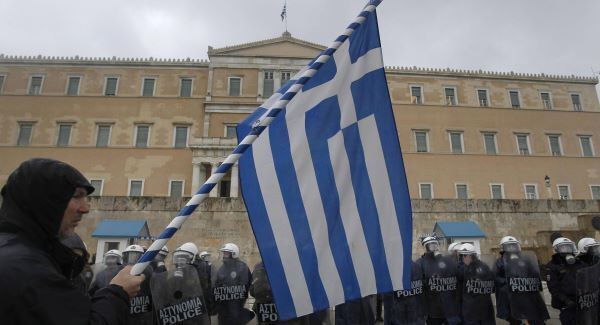
Austerity-weary Greeks have taken to the streets in often violent protests against waves of cuts that have driven many to the edge.
Prime Minister Antonis Samaras, who met the troika chiefs last night to convince them to lift their last objections, has vowed this is the last round of cuts.
Dozens of protesters waving Greek flags and shouting “out with the troika” jeered as officials entered the finance ministry.
At stake is a €31.5bn installment from a €130bn second bailout keeping Greece afloat. Lenders have made clear no money will be disbursed without credible measures.
However, two German magazines reported that Athens will receive its next aid tranche despite budget shortfalls and slow progress on reforms because the eurozone does not want any country to leave the bloc.
Lenders are coming to terms with the fact Greece will need more time, more funding, or a restructuring of the official debt owed to European governments, to survive. Sources say the IMF would prefer bondholders to take another haircut but EU governments, which would incur most of the losses, would rather give Athens more time.
“Those who accept Greece’s optimistic predictions want to gain time to resolve the debt crisis overall,” Damalas said.
“But talk has already begun that the austerity measures are not enough and a new, official haircut will be needed, which explains the tension between the IMF and the EU.”
CONNECT WITH US TODAY



Be the first to know the latest news and updates