Student held for plan to attack Pope protesters
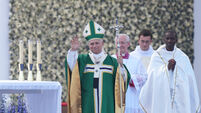
Pope Benedict XVI is due to arrive in Madrid today for a four-day visit to celebrate World Youth Day.
A police official said the suspect arrested in the capital is a 24-year-old Mexican student specialising in organic chemistry.
She would not say whether investigators believe the man was actually capable of carrying out a gas attack, and did not know if he actually had chemicals for one.
The Mexican embassy identified the detainee as Jose Perez Bautista and said he was from Puebla state, near Mexico City.
He was arrested at a Madrid convention centre where hundreds of thousands of pilgrims coming to town for the papal visit pick up their accreditation.
An official with the visit’s organising committee said Bautista was a volunteer working to help deal with the massive flow of people into Madrid.
A total of 30,000 people from around the world are taking part in the organising effort and 10,000 police are providing security in Madrid, and organisers say they expect more than one million pilgrims to attend World Youth Day, which started on Tuesday and runs through to Sunday.
Police have 72 hours from the time of the arrest to bring Bautista before a judge at the National Court for questioning or to release him.
The official — speaking on condition of anonymity — said Bautista had been making threats over the internet against people in Spain opposed to the Pope’s visit, and police who had been monitoring his online activity ultimately decided to arrest him as the visit approached.
Police said in a statement that officers who searched Bautista’s apartment in a wealthy district of Madrid seized an external hard-drive and two notebooks with chemical equations that had nothing to do with his studies.
It said he tried to recruit people via the internet to help him, and that a computer allegedly used for this purpose was among objects seized by police.
Bautista had planned to attack anti-Pope protesters with “suffocating gases” and other chemicals, the statement said. But it did not mention police confiscating chemicals that could be used in an attack.
Mexican embassy spokes-man Bernardo Graue said consular officials had visited Bautista in prison and described him as “relaxed” and in good physical condition as he waits to go before a judge.
The Mexican officials did not ask him if he had planned a gas attack, because interrogating him is up to Spanish authorities, Graue said.
Without knowing what chemicals and delivery system Bautista may have had, it is impossible to know what harm he could have caused on protesters marching in open air through the streets of Madrid, as happened yesterday evening, said Magnus Ranstorp, a terrorism expert at the Swedish National Defence College in Stockholm.
Bautista was in Madrid studying with Spain’s top government research body, the Spanish National Research Council, and his office there was searched, police revealed.
The council confirmed the arrest but gave no immediate details on Bautista.
Mexico’s Autonomous University of Puebla confirmed that a man with the same name had completed an undergraduate degree in chemistry in 2009 and had expressed interest in doing graduate work in Spain.
“Both the name and the academic background match,” said Rafael Hernandez Oropeza, the university’s director of international relations.
He said Bautista had an 8.6 grade average out of 10, “which is pretty high”.
He said the university had neither arranged Bautista’s enrolment or any scholarship for study in Spain and was checking with the country’s national science and technology council to see if it had done so.
Church organisers say the papal visit is costing about €50 million to stage.
Protesters complain the Spanish government is essentially spending taxpayers’ money on the visit by granting tax breaks to corporate sponsors and perks such as subway discounts and bus tickets for pilgrims.
The Pope’s attendance shows how much a priority he places on the economically troubled country, which has departed sharply from its Catholic traditions.
In the economic downturn, he may be hoping to lure back some of his straying flock.
This will be the third time the pontiff visits Spain since his papacy began in 2005, and the second in less than a year.
But many Spaniards have taken issue with the hoopla and hefty cost.
The visit also comes as Spain gets ready for early elections in November.
And while the Church officially keeps out of politics, it will be sure to be watching closely — as the outcome could affect Spain’s direction on hot-button ethical issues.
The election will pit the ruling Socialists, who irked the Vatican with social reforms including gay marriage and a law allowing 16-year-olds to get abortions without parental consent, against conservatives who tend to back Church thinking on such issues and are heavily favoured to win.
Spain’s economy is stuttering as it seeks to overcome recession, Madrid’s stock market has been a rollercoaster of late, the government is saddled with debt woes, and young Spaniards feel doomed and angry over their grim prospects amid a nearly 21% unemployment rate.

CONNECT WITH US TODAY



Be the first to know the latest news and updates