Arrest doubts as Haitian police take ex-dictator to court
His longtime companion denied he had been arrested.
A contingent of police led the former dictator known as “Baby Doc” through the hotel and to a waiting SUV. He was not wearing handcuffs.
Duvalier, 59, was calm and did not say anything, ignoring questions from journalists, as he was led away to cheers from some and jeers from others.
The SUV drove in a convoy of police vehicles to a courthouse, even as dozens of Duvalier supporters tried to block streets with overturned trash bins and rocks to try to prevent the former dictator from going to prison.
The courthouse was thronged with spectators and journalists, who were not permitted to enter to view the proceedings.
His companion, Veronique Roy, spoke to an Associated Press reporter by phone from inside the court, and when asked if Duvalier had been arrested, said, “Absolutely not.”
She said she did not know why authorities decided to escort him to court and did not expect to be there much longer. “We are very relaxed, drinking coffee and water,” she told AP. “They said they are making photocopies. We don’t know why.”
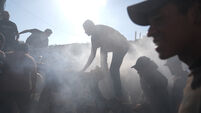
Several hundred Duvalier supporters gathered outside the court, burning tires, chanting slogans and calling for the arrest of President Rene Preval.
56-year-old Chal Christen, waved a flag of Duvalier’s political party — one he said he’d had stored away since the one-time “president for life” was deposed in a popular uprising and forced into exile nearly 25 years ago.
“We don’t have food, our houses collapsed, our children can’t go to school. It’s Preval that is the dictator,” Christen said. “We want Duvalier for president. Under him we ate well, we were safe.”
Fenel Alexi, a 31-year-old mechanic, denounced both Duvalier and Preval.
“The citizens have endured so much crime. We haven’t had a president who hasn’t committed crimes.”
The UN High Commissioner for Human Rights spokesman Rupert Colville said Duvalier’s return increases the chance he could be charged with atrocities committed during his 15-year rule because it will be easier to bring charges in the country where the crimes occurred.
He cautioned, though, Haiti’s fragile judicial system may be in no position to mount a case.

CONNECT WITH US TODAY



Be the first to know the latest news and updates