Heat wave intensifies Ramadan challenge

MORE than a billion Muslims around the world began observing the holy month of Ramadan yesterday, with the dawn-to-dusk fast posing a particular challenge for the devout in the sweltering Middle East.

Heat wave intensifies Ramadan challenge

A heat wave has covered much of the region, putting even the most ardent believers to the test.

In some places – such as Egypt, Lebanon and the Gaza Strip – the hardship of abstaining from food, drink and cigarettes for 15 hours a day was compounded by frequent power outages.

“I’m not sure if I can continue fasting,” lamented Ismail Abu-Hasweh, 28, in Amman, Jordan. “I’m a chain smoker and I feel lightheaded because I didn’t smoke or drink my coffee,” he added.

Ali Shishi, 30, working in a downtown public garden in Damascus, Syria, said he planned to work a full shift. “My fasting will not be accepted by God if I quit my work,” he said.

But his manager told him just before noon he should stop working because it got too hot.

In Cairo, barber Mohammed Abdo said working and reading the Koran keeps his mind off his stomach.

The start of Ramadan changes every year, based on the sighting of the new moon at the start of the lunar month. The calculation can be a show of regional clout, with senior clerics and the two main sects of Islam often disagreeing. Most Sunni Muslims began fasting yesterday, while Shi’ite Muslims in Iran, Iraq and Oman are to begin observances today. Lebanon’s Shi’ites were split.

By midday, temperatures topped 100F, or 38C, in much of the region.

Some took steps to ease the burden of fasting in the heat. The governments in Jordan, Lebanon and the Palestinian territories reduced the work day of civil servants from eight to six hours. Some construction workers in Lebanon struck deals with their employers to work for a few hours at night.

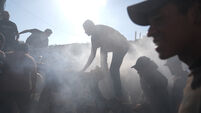
In Gaza, power outages were one of the biggest concerns. In the worst periods, electricity is off for 12 hours, on for four, then off again for 12. The blackouts are caused by an overburdened grid, unrepaired damage from Israeli military offensives and a dispute between the Islamic militants Hamas and the Palestinian government in the West Bank over who should pay for fuel for Gaza’s only power plant.

More in this section

Cookie Policy Privacy Policy Brand Safety FAQ Help Contact Us Terms and Conditions

© Examiner Echo Group Limited