Former PM shrugs off nerves to declare: I’ve no regrets

IN THE end it took less than his famous “45 minutes” for Tony Blair to crack and confess to the Iraq Inquiry that he had got it wrong.

It was not the mea culpa over invading Iraq dreamed of by the hundreds of critics shouting through the rain for the former prime minister to stand trial for war crimes.

In fact, after six hours of strident defiance, a “no regrets” declaration eventually breached the dam of emotions in the room, raining shouts of “liar” and “murderer” on to the key witness.

Instead, in what he implicitly acknowledged was a stunning slip for such a notoriously polished performer, it was to concede he had “something to learn” about doing television interviews.

Of course, he laughed, in a doomed attempt to slam shut a chink of vulnerability glimpsed by foes, he had not meant it when he told Fern Britton any excuse would do for toppling Saddam.

It was one of very few light-hearted moments in the opening hours of the ex-premier’s grilling within a stone’s throw of where he made the decision to commit British troops. He obviously found nothing amusing in the protesters awaiting him outside – albeit a paltry gathering next to the million or so who took to the same streets in 2003. Such was his determination to evade them a decoy convoy was deployed to cover his early arrival through the back door – once again “behind the backs” of voters, as one complained.

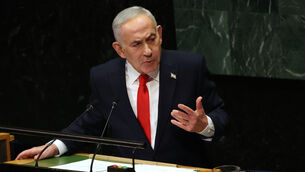
However much preparation time his two-hour head start gave him, however, the star witness looked like a man whose moment in the spotlight had been thrust on him unexpectedly. His usual immaculate blue suit, red tie and white shirt – picked perhaps to show off his Middle East peace envoy tan – were offset by a nervousness as visible as it was unusual.

If what he needed to calm his nerves was to start doing what he does best – making a case – his opening inquisitor Roderic Lyne was in no mood to stop him sweating. As Blair entwined the fingers of both hands ever closer, the diplomat – in a technique maybe learned in his time as British ambassador to Moscow – opened with a question almost 10 minutes long.

Even as he began to make his case – soon deploying the familiar Blair prop of popping on and off his glasses – some of that famous self-confidence appeared to have gone AWOL. It was a deliberate but nervous-seeming ex-PM who insisted he consulted his cabinet and deployed an opening sound bite, decrying the “binary distinction” drawn between WMD and regime change. Opponents scenting blood were quickly disappointed, however, as the famous Blair assurance began to show through, his own light-hearted effort to defuse the Fern timebomb helping break the spell.

Soon he was not just in his stride but, reciting chunks of his own speeches plucked from a tatty lever-arch file of archive papers, forced to stop to allow the stenographer to catch up.

He did not spare criticism of others, notably former head UN weapons inspector “Blix” – the Hans was pointedly dropped several times – who he accused of changing his tune over Saddam. Nor did he recoil from admitting one personal error – not correcting the 45-minute claim – although only as part of a valiant effort to downplay the significance of the issue at all.

But however forensic the analysis of his decision to go to war was now, Blair had one clear message to get across: it was just that, “a decision, my decision and one I would make again”.

There was, inevitably from the man who felt the hand of history on his shoulder, a sound bite to summarise it: “This isn’t about a lie or a conspiracy or a deceit or a deception. It’s a decision.”

Wouldn’t it have been “irresponsible” to ignore all that evidence and history, he asked, daring his critics to ask themselves the “2010 question” rather than the 2003 version.

There will have been many in the public seats behind him straining at the leash to answer him in no uncertain terms, not least the bereaved relatives of the Iraq war dead among them. While they could faintly hear the shouts of the massed ranks gathered behind an extensive police cordon outside, John Chilcot’s appeal for best behaviour was mostly heeded.

For almost six hours, those select few pulled out of the hat to take the limited seats listened in silence. Few were on the edge of those fiercely contested seats however, as expectations of an electrifying spectacle were deflated by Blair’s assured performance. Indeed, some will be glad they were not visible to the hundreds who lost out in the ballot for places – retribution might have been sought on the several seen to fall asleep after lunch. But with the invasion – and especially its human cost both among British troops and Iraqi civilians – still provoking such powerful emotions, the quiet was never likely to last. When the outbursts came they were loud, direct and designed to ensure Blair left with contempt ringing in his ears. In a dramatic finale, the former PM was offered a chance by Chilcot to finish by expressing the sorts of regret his fiercest critics crave to hear from his lips.

“Responsibility but not a regret for removing Saddam Hussein,” was the furthest he would go – sparking the first cry of “What, no regrets? Come on.” Silence was temporarily restored but only until Blair, who consistently denied any regret, stood to leave to shouts of “you are a liar”... “and a murderer”.

x

More in this section

Cookie Policy Privacy Policy Brand Safety FAQ Help Contact Us Terms and Conditions

© Examiner Echo Group Limited