Urgent resources are still not getting to desperate survivors
Help was not reaching many victims of last Tuesday’s quake — choked back by transport bottlenecks, bureaucratic confusion, fear of attacks on aid convoys, the collapse of local authority and the sheer scale of the need.
“We don’t need military aid. What we need is food and shelter,” one man yelled at UN Secretary-General Ban Ki-moon during his visit to Port-au-Prince. “We are dying,” a woman told him.
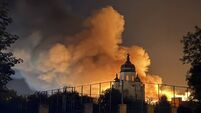
Meanwhile, Haitian riot police fired tear gas to disperse crowds of looters in the city centre as nearby shops burned.
“We’ve been ordered not to shoot at people unless completely necessary,” said police officer Pierre Roger as a crowd of looters ran by. “We’re too little, and these people are too desperate.”
Looting spread as hundreds of young men and boys clambered up broken walls to break into shops and take whatever they could find.
Especially prized is toothpaste, which people smear under their noses to fend off the stench of decaying bodies.
At one place, youths fought over a stock of rum with broken bottles, machetes and razors and police fired shots into the air to break up the crowd.
“I am drinking as much as I can. It gives courage,” said one, wielding a broken wooden plank with nails to protect his bottle of rum.
The US ambassador to Haiti, Kenneth Merten, acknowledged that “the security situation is obviously not perfect”, but said new troops scheduled to arrive during the day were meant to back up Haitian police and UN personnel, not replace them.
The Pan American Health Organisation estimates 50,000 to 100,000 died in the 7.0-magnitude quake and Haitian officials believe the number is higher.
Many survivors have lost their homes and many live outside for fear unstable buildings could collapse in aftershocks.
So many people have lost homes that the World Food Programme is planning a tent camp for 100,000 people on the outskirts of Port-au-Prince.
On the streets, people were still dying, pregnant women were giving birth and the injured were showing up in wheel-barrows and on people’s backs at hurriedly-erected field hospitals.
Water began to reach more people around the capital and while fights broke out elsewhere, people queued to get supplies handed out by soldiers at a golf course.
But with a blocked city port and relief groups claiming the US-run airport is being poorly managed, food and medicine were scarce. Anger mounted hourly over the slow pace of the assistance.
“White guys, get the hell out!” some survivors shouted in the city’s Bel-Air slum, apparently frustrated at the sight of foreigners who were not delivering help.
Doctors Without Borders said bluntly: “There is little sign of significant aid distribution.”
The aid group complained of skewed priorities and a supply bottleneck at the airport. A spokesman said the US military needed “to be clear on its prioritisation of medical supplies and equipment.”
The on-the-ground US commander in Haiti, Lt Gen Ken Keen, acknowledged the bottleneck at the airport with a single runway and little space for parked planes. “We’re working aggressively to open up other ways to get in here,” he said.
Part of that will be fixing Port-au-Prince’s harbour, rendered useless for incoming aid because of quake damage.
Keen said the city is seeing less violence than before the earthquake. “Is there gang violence? Yes. Was there gang violence before the earthquake? Absolutely.”
He said 2,000 Marines were set to join 1,000 US troops on the ground and UN Secretary General Ban Ki-moon announced yesterday he wants 1,500 more UN police and 2,000 more troops to join the existing 7,000 military peacekeepers and 2,100 international police in Haiti.
Five days after the quake struck more survivors were freed from under piles of concrete and debris.
Teams with search dogs rescued a 16-year-old Dominican girl trapped for five days in a three-storey hotel that crumbled in central Port-au-Prince.
At the UN headquarters destroyed in the quake, rescuers lifted a Danish staff member alive from the ruins — just 15 minutes after Secretary-General Ban visited the site where UN mission chief Hedi Annabi and at least 39 other staff members were killed.
A government minister said 70,000 bodies had already been collected and officials fear the death toll may top 200,000.
Meanwhile, a text message to the UN led to the rescue two days later of Maria, Ariel and Lamy after being buried for more than 100 hours under a collapsed supermarket.
“I’m seven,” Ariel shouted to rescuers seeking signs of life, adding that she was next to a dead man and covered with supermarket food.
“It was electric when we saw the fruit of our labour, when that little girl came out,” said Joseph Fernandez, of a Florida search and rescue team.
The German co-owner of a Port-au-Prince hotel also sent a text message that led to her rescue after spending four days under the debris.

CONNECT WITH US TODAY



Be the first to know the latest news and updates