Thousands feared trapped in Indonesian quake
At least 75 people were killed on Sumatra island and the death toll was expected to climb sharply.
The magnitude 7.6 quake struck at 5.15pm. local time (10.15GMT), just off the coast of Padang city, the US Geological Survey said.
It was along the same fault line that the massive 2004 Asian tsunami that killed more than 232,000 people in a dozen countries was spawned.
A tsunami warning for countries along the Indian Ocean was issued, and panicked residents fled to higher ground fearing giant waves. The warning was lifted about an hour later.
Initial reports received by the government said 75 people were killed, but the real number is “definitely higher than that,” Vice-President Jusuf Kalla toldreporters in the capital, Jakarta.
“It’s hard to tell because there is heavy rain and a blackout,” he said.
Health minister Siti Fadilah Supari told MetroTV that a shopping mall and two hospitals had collapsed in Padang – a sprawling low-lying city in Western Sumatra province of around 900,000 that geologists have warned could be vulnerable to a massive quake or tsunami.
“This is a high-scale disaster, more powerful than the earthquake in Yogyakarta in 2006 when more than 3,000 people died,” Supari said, referring to a major city on the main island of Java.
Rustam Pakaya, head of the Health Ministry’s crisis centre, said “thousands of people are trapped under the collapsed houses”.
A field hospital was being prepared to assist the injured and medical teams were on the way from neighbouring provinces, he said.
“Many buildings are badly damaged, including hotels and mosques,” said Wandono, an official at Meteorology and Geophysics Agency in Jakarta, citing reports from residents.
Footage from Padang showed flattened buildings, the foot of one person sticking out from beneath the debris.
“The earthquake was very strong,” said Kasmiati, who lives on the coast near the epicentre. “People ran to high ground. Houses and buildings were badly damaged.”
“I was outside, so I am safe, but my children at home were injured,” she said before her phone went dead.
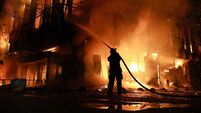
TV One network said the quake triggered landslides that cut all roads to Padang. Power and telecommunications were also cut. Fire also broke out in buildings on a road to the city, officials said.
“I want to know what happened to my sister and her husband,” said Fitra Jaya, who owns a house in downtown Padang and was in Jakarta when the quake struck. “I tried to call my family there, but I could not reach anyone at all.”
The shaking could be felt in high buildings in Jakarta, several hundred miles away. It was also felt in neighbouring Singapore and Malaysia.
Padang was badly hit by an 8.4 magnitude quake in September 2007, when dozens of people died and several large buildings collapsed.
A resident called Adi later told Metro Television there was devastation around him.
“For now I can’t see dead bodies, just collapsed houses. Some half-destroyed, others completely. People are standing around too scared to go back inside. They fear a tsunami,” said Adi.
“No help has arrived yet. I can see small children standing around carrying blankets. Some people are looking for relatives, but all the lights have gone out completely.”
Sumatra is home to some of the country’s largest oil fields as well as its oldest liquified natural gas terminal, although there were no immediate reports of damage to those facilities.
Padang, capital of Indonesia’s West Sumatra province, sits on one of the world’s most active fault lines along the “Ring of Fire” where the Indo-Australia plate grinds against the Eurasia plate to create regular tremors and sometimes quakes.
A 9.15 magnitude quake, with its epicentre roughly 600km northwest of Padang, caused the 2004 tsunami which killed 232,000 people in Indonesia’s Aceh province, Thailand, Sri Lanka, India, and other countries across the Indian Ocean.