Baghdad blasts kill 95 on bloodiest day of the year

A SERIES of blasts in Baghdad yesterday killed 95 people and wounded 536 in Iraq’s bloodiest day this year, renewing doubt over Iraqi forces’ ability to maintain security after US troops pulled out of urban areas.

Baghdad’s security spokesman made a rare admission of culpability after the attacks, in which at least six blasts struck near government ministries and other targets at the heart of Iraq’s Shi’ite-led administration.

“This operation shows negligence, and is considered a security breach for which Iraqi forces must take most of the blame,” Major General Qassim al-Moussawi told Iraqiya state TV.

The government said this month that most of the city’s blast walls would be removed within 40 days, a sign of confidence in its security forces after US combat troops withdrew from urban centres in June, and ahead of elections due in January.

Yesterday’s blasts were a rare example of a co-ordinated attack on heavily guarded targets.

In one blast, a truck bomb close to a security checkpoint leading to the heavily fortified Green Zone blew out the windows of the nearby foreign ministry, sending shards of glass through busy offices, killing dozens of people.

“The windows of the foreign ministry shattered, slaughtering people inside. I could see ministry workers, journalists and security guards among the dead,” said a ministry employee.

The explosion was powerful enough to shatter some windows of Iraq’s parliament building in the Green Zone. The attacks could undermine confidence in Prime Minister Nuri al-Maliki ahead of the parliamentary election.

Maliki and others have said such bombings are likely to increase as the January poll nears.

“They are meant to convey a message to Iraqis and the world that insurgents are still there and can block the political process,” said analyst Hameed Fadhel of Baghdad University.

“The attacks reveal a major deficiency and weakness of the security forces,” he added.

No group claimed responsibility, but Moussawi said two members of al-Qaida were arrested when another car bomb was intercepted.

Sunni Islamist groups like al-Qaida consider Shi’ites heretics, and have been blamed for a series of blasts in the last two months at mostly Shi’ite venues such as mosques both in the capital and in northern Iraq where insurgents have exploited rows between Kurds and Arabs.

Another truck bomb in Baghdad’s Waziriya district near the finance ministry killed at least 28 people and caused widespread destruction, police said. Part of a raised highway near the building collapsed, a witness said.

“Suddenly a powerful blast shook the building and glass flew... Most employees were wounded by the flying glass and others, including myself, suffered concussion... I awoke with blood all over my face,” said ministry worker Batoul al-Amri.

Iraqi lawmakers and officials have accused neighbouring states of fomenting violence in Iraq, including Saudi Arabia, Iran and Syria. Analysts say that could be a ploy to distract attention from domestic disputes and failings.

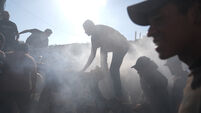
Another explosion was close enough to offices in central Baghdad’s Karrada district to burst open windows and doors. Columns of smoke could be seen rising from several sites.

The Baghdad provincial government building came under mortar attack, police said, as did the Salhiya district in central Baghdad, home to army bases and a television station.

At least one suspected mortar landed near the United Nations compound in the Green Zone, startling UN workers marking the sixth anniversary of the destruction of their previous Baghdad headquarters by a truck bomb which killed envoy Sergio Vieira de Mello and other staff, UN guards said.

The US military said it had no reports of mortar fire.

In Bayaa, in southern Baghdad, a blast killed two people.

More in this section

Cookie Policy Privacy Policy Brand Safety FAQ Help Contact Us Terms and Conditions

© Examiner Echo Group Limited