20 killed as suicide bomber hits UN
Sergio Vieira de Mello died and over 100 were injured in the attack.
One UN official said a yellow cement truck crashed into the building and blew up, sending a huge cloud of smoke into the sky over the Iraqi capital. A top US official said there was evidence to suggest a suicide bomber had carried out the attack, which blew out windows as far as a mile away.
President George W Bush, speaking from his ranch in Texas, called the attackers "enemies of the civilised world".
The Security Council called the bombing a "terrorist attack". It came 12 days after a car bombing at the Jordanian Embassy in Baghdad killed 11 people.
The UN said Mr Vieira de Mello had been trapped in the rubble of his office.
Rescuers had battled in vain to reach him. UN worker Salim Lome said the blast was directly under the office of the Brazilian UN chief, which was completely wrecked.
One UN worker at the scene, Tharer al-Tikriti, said he counted 15 white body bags taken from the collapsed building, where about 300 people worked. "There were foreigners and Iraqis inside (the body bags)," he said.
The attack resembled those blamed on Islamic militants elsewhere in the world. It was far more sophisticated than the campaign of guerrilla attacks that has plagued US forces generally hit-and-run shootings carried out by small bands, or remote-controlled roadside bombs.
The blast happened at about 4.30pm local time, just hours after the US said it had caught former Iraqi vice president Taha Yassin Ramadan.
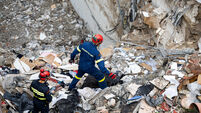
Paul Bremer, the top US official in Iraq, walked through the scene of destruction as workers, covered with blood, dug through the rubble.
Several floors of the shattered building had collapsed on top of each other at the front of the building, and rescuers scrambled over the rubble.
An AP reporter saw 40 injured people receiving first aid in a nearby garden. "I can't move. I can't feel my legs and arms. Dozens of people I know are still under the ruins," said Majid Al-Hamaidi, 43, a driver for the World Bank.
UN employee Alice Yacoub said she was sitting in the cafeteria when the blast went off. "Everything came down on our head, I can't find my colleagues and I am worried about them," she said.
"My colleague Talal is still under the rubble and he will die if somebody doesn't help him soon," said Jwan Al-Jaff, a UN travel agent.
One wounded man had a yard-long, inch-thick aluminium rod driven into his face just below his right eye. He was able to speak and identified himself as a security consultant for the International Monetary Fund. A senior Unicef official was also seriously wounded in the blast, UN officials said. Dozens of American Humvees were at the scene and Black Hawk helicopters hovered above. Some were ferrying the wounded away for treatment.
The UN headquarters was based in a former hotel the Canal and its weapons inspectors worked out of the building before the war.