Officials investigate cause of rail disaster
The disaster killed at least 320 people and injured hundreds more.
An iron wedge used on Iranian trains to secure the wheels of the lead car was broken, and it was unclear if brakes on individual cars were working, said Hassan Rasouli, governor of Iran's north-eastern Khorasan province.
Workers at the yard also may have been at fault, he said.
At the scene, relatives scanned lists of the dead for loved ones, as rescuers choking on fumes managed to extinguish flames that burned for nearly 24 hours. At least 460 people were wounded, the governor said. The train loaded with cargo including petrol, fertiliser, sulphur and cotton somehow started rolling from a station before dawn on Wednesday. It started on a downward slope going 93 mph and travelled for 31 miles before hitting a sharp turn at the next station. There, all but three cars jumped the track and caught fire.
The wrecked train burned for more than five hours before the hazardous mix of its contents exploded, killing firefighters, rescue workers, spectators and people in nearby villages shook by the force of the blast.
The cause of the disaster was under investigation. "One possible cause is negligence of the personnel at the station," said Rasouli, governor. "The other is technical failure of the braking system."
"What we do know is that the brake that is put in front of the cars was broken," he said.
The slight decline going out of the station gave the cars momentum, Rasouli said. Officials estimated the train's 93 mph speed based on how long it took for it to cover the distance from the station to the point where it derailed.
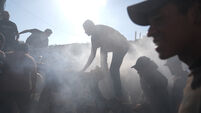
Bulldozers and cranes were used to sort through the debris of burned train cars and nearby villages devastated by the explosion 20 miles east of Neyshabur. Emergency workers collected human remains torn by a blast so powerful it collapsed mud homes in five villages, shattered windows as far as six miles away and left a crater 50 feet deep.
In an apparent indication of the explosion's force, Iranian seismologists recorded a 3.6-magnitude tremor in the area at the moment of the blast.
Stunned residents of Neyshabur turned out for the funeral of their governor, Mojtaba Farahmand-Nekou, who with the fire chief was among several city officials killed in the explosion. More than 20,000 mourners, all wearing black, looked on as the body, wrapped in the red-white-and-green Iranian flag, was driven through the city.
Shops and offices closed for three days of mourning. Survivors looked through lists of the dead posted outside hospitals and clinics.
Eighty percent of those injured were hurt when their homes collapsed, and the rest were either burned or hurt from the force of the explosion.