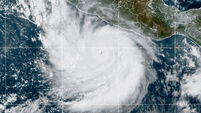
Warm, deep water creates a ‘perfect storm’
Rita, following in Katrina’s wake, zipped from a tropical storm to a Category Five hurricane in a breathtakingly short 30 hours.
That’s because Rita and Katrina both found the perfect hurricane fuel - ultra-deep, super-warm water - and then lingered there, storm researchers said.
The result: for the first time in one hurricane season, two Category Five hurricanes powered across the Gulf of Mexico toward the US coast.
The storm was forecast to hit near Port Arthur in Texas late last night or early today after its path shifted a bit north.
As was expected, the US National Hurricane Centre downgraded Rita to a Category Three storm last night before it smashed into the Texas coast.
Rita’s atmospheric pressure at its centre was dangerously low, at 907 millibars in the latest advisory, making it the third most intense storm ever recorded in the Atlantic basin. The lower the pressure in the centre of a hurricane, the stronger the storm.
Katrina, which was once a Category Five storm but came ashore as a Category Four with 140mph (225km/h) winds, had a pressure of 923 millibars when it made landfall. Forecasters said Rita could be the most intense hurricane on record ever to hit Texas, and one of the most powerful ever to plough into the US mainland.
Category Five is the highest on the scale, and only three Category Five hurricanes are known to have hit the US mainland - most recently, Andrew, which smashed Florida in 1992.
Rita was moving west at nearly 14km/h. Forecasters predicted it would come ashore along the central Texas coast between Galveston and Corpus Christi.
But with its breathtaking size - tropical storm-force winds extending 370 miles across - practically the entire western end of the US Gulf Coast was in peril.
Both Katrina and Rita hit what scientists call the Loop Current, an annual 160km swath of 28-degree Celsius water between the Florida Keys and the mouth of the Mississippi River that’s 90 metres deep, said Frank Marks, the director of the Hurricane Research Division of the National Oceanic and Atmospheric Administration. Normally, warm water is about 38m deep.
That deep pool of warm water “is enough to make a really nasty hurricane”, said Hugh Willoughby, senior hurricane scientist at Florida International University.
Mostly, hurricanes cross the loop, intensify, then get back to cooler waters where they weaken. But both Katrina and Rita “are going straight down the slot like a barrel of a shotgun”, Mr Marks said.
CONNECT WITH US TODAY



Be the first to know the latest news and updates