Quake survivors scramble for food as aid arrives by mule

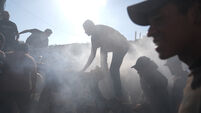
ABOUT 200 desperate people pushed and fought each other for milk, bread and biscuits brought in by mule train yesterday.

Quake survivors scramble for food as aid arrives by mule

It was the first aid to reach their distant mountain village since Pakistan's earthquake left them homeless two weeks ago.

A helicopter carrying more supplies turned back after seeing the chaos below in the remote settlement of Ghanool in Pakistan's North West Frontier Province.

In other mountain villages, survivors were still crying out for shelter from the frigid weather. The October 8 quake left some 3.3 million people homeless and killed nearly 80,000.

"It's horrible," said Hanna Mattinen, an aid worker with the group Action Against Hunger in the village of Paras, which needed 1,000 tents but only had 150. Men were forced to sleep outside, while women and children shared the tents.

"The needs are just indescribable," Mattinen said.

In Kashmir, snow has begun to fall in high mountains, and temperatures are dipping below freezing in some villages at night. Aid workers fear casualties will rise because communities are without adequate food, shelter or health care.

Turkish Prime Minister Recep Tayyip Erdogan offered $150 million in cash and aid after he surveyed the devastation by helicopter with Pakistan's Prime Minister Shaukat Aziz yesterday.

"We will do whatever is possible to assist you in this crisis," Erdogan said in Muzaffarabad, the capital of Pakistani-controlled Kashmir.

The pledge made Turkey the biggest single donor nation so far in a faltering relief effort.

UN relief coordinator Jan Egeland says the UN has received only 27% of its appeal for $312 million in quake relief - compared with 80% pledged within 10 days of a similar appeal to international donors after the South Asian tsunami.

Egeland called on NATO countries to launch "a second Berlin airlift", referring to the nonstop flights by Western pilots into West Berlin in the 1940s when Soviet forces sealed off the city.

He said the logistics of aid in the freezing, mountainous and remote Himalayan region were more complicated than the efforts following the December 26 earthquake and tsunami, which killed more than 176,000 people.

NATO was expected to approve a dispatch of medics and military engineers to clear roads in the quake zone spanning from northwestern Pakistan into India's part of divided Kashmir.

But allied commanders are struggling to muster helicopters needed to carry aid into remote mountains. The United States, Germany, Japan and Afghanistan have already sent choppers.

Medecins Sans Frontieres' emergency co-ordinator for Bagh, Kashmir, Krist Tierlinck said: "Every case now left behind is becoming a very serious case."

x

More in this section

Cookie Policy Privacy Policy Brand Safety FAQ Help Contact Us Terms and Conditions

© Examiner Echo Group Limited