US marines target insurgents after battles
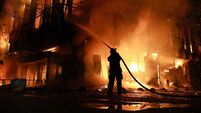
About 800 US marines and 180 Iraqi soldiers moved into Haqlaniyah, one of a cluster of western towns in Anbar province around the Haditha Dam that is believed to be a stronghold of Iraqi insurgents and foreign fighters.
Heavy Abrams tanks battled insurgents armed with rifles and rocket-propelled grenades, while US jets destroyed at least four buildings - two of which were found booby-trapped with explosives, a US military statement said.
“The wires were connected to numerous 155-mm artillery rounds scattered throughout both buildings,” the military said.
Operation Quick Strike is the third major campaign since May aimed at rooting out insurgents in the Euphrates valley, believed to be a major infiltration route for extremists entering Iraq from Syria.
On Wednesday, 14 marines and a civilian translator were killed near Haditha when a huge roadside bomb wrecked their lightly armoured vehicle.
Two days earlier, six marine snipers died in a gunbattle with insurgents. The Islamic militant group Ansar al-Sunnah claimed its men staged both attacks.
Two other marines have died in Anbar this week - one from a car bomb, the other from small arms fire.
Residents said US and Iraqi troops had cordoned off Haqlaniyah, about 140 miles north-west of Baghdad, and were searching house to house. US warplanes prowled overhead and a number of heavy explosions were heard. Witnesses said 500lb bombs were dropped in the area.
The US military has defended its operations in western Iraq, insisting it is reducing insurgent attacks despite the nearly two dozen marine deaths this week. As of Thursday, at least 1,826 US military personnel had died since the beginning of the Iraq war.
Iraq’s leading Shi’ite Muslim cleric, meanwhile, signalled he wants Islam as the foundation of the country’s legal system, setting the stage for a showdown next week as politicians struggle to finish the draft of a constitution by the August 15 deadline.
In Najaf, Prime Minister Ibrahim al-Jaafari conferred with Shi’ite religious leaders, who wield strong influence among Iraq’s majority Shi’ite population.
During the meetings, Grand Ayatollah Ali al-Sistani told Mr al-Jaafari that he would like the constitution to enshrine Islam as the main source of legislation, the prime minister said.
“Ayatollah al-Sistani does not want to impose dictation on drafting the constitution, but according to my knowledge, he hopes Islam becomes the main source of legislation,” Mr al-Jaafari said.
The role of Islam in the constitution has been one of the major sources of contention among the committee drafting the charter.
Designating Islam as the main source of law is opposed by Kurds and some Iraqi women, who fear a major rollback of their rights.
CONNECT WITH US TODAY



Be the first to know the latest news and updates